Header image: data center aisle. Photo: Brett Sayles / Pexels.
Kimi K3.1 Pro is live. Moonshot AI launched it on October 23, 2026, as the first model in its K3.1 series: a million-token context window, API access today, and a promise that full Kimi K3.1 open weights ship by November 4. For a small shop the useful questions are narrower than the launch blog. What does Kimi K3.1 Pro pricing look like on the meter? Which Kimi K3.1 Pro benchmarks are third-party measurements versus Moonshot’s own tables? And can you actually run it locally once the files hit Kimi K3 Hugging Face (the usual place people search for Moonshot checkpoints)—or should you just call the API?
This piece sticks to what Moonshot, Artificial Analysis, The Next Web and NextFor have published, labels vendor claims as vendor claims, and separates interpretation from measurement. We have not run the model ourselves.
Note (October 24, 2026): Launch was yesterday. Full weights are not downloadable; Hugging Face still lists Kimi K3, not K3.1 Pro. Pricing from platform.kimi.ai as read today. Moonshot and Artificial Analysis benchmark numbers do not always match—re-check both before you budget or self-host.
What Moonshot launched on October 23
Per Moonshot’s Kimi K3.1 Pro blog and API quickstart, two models shipped: kimi-k3.1-pro (flagship; thinking always on; reasoning effort low / high / max, default max) and kimi-k3.1-pro-highspeed (Moonshot says 2–3× Pro speed; platform page: “roughly 3×”). Both are live on Kimi.ai, mobile apps, Kimi Work (3.1.0+), Kimi Code (/model) and the API at https://api.moonshot.ai/v1. Enterprise access is off by default. Full weights: “by Nov 4” / “by Nov 4, 2026”—not today.
Moonshot calls it its most capable “3T-class open-weight model to date,” a post-trained Kimi K3 upgrade with a 1-million-token context. API extras: vision, tools, structured JSON, automatic caching (5m or 1h TTL). Flagship API access needs a ≥$1 top-up; spend sets rate-limit tiers.
Specs: 1M context, and the ~2.8T / 104B size claim
Context is consistent across Moonshot’s blog, quickstart and pricing page: 1,048,576 tokens, flat pricing, no context-length tiers.
Parameter count needs a label. Moonshot markets “3T-class.” Artificial Analysis lists 2.8T total / 104B active, text + image, weights not published. NextFor cites the same ballpark via MarkTechPost as reporting, not a lab sheet. The MoE-style split matches how Kimi K3 was described. Treat 2.8T / 104B as a repeated report—we have not measured a weight file, because none is public yet.
API modalities: text and vision (base64 or Moonshot file IDs; public image URLs unsupported per docs). Official web search is “being updated” and not recommended for production near-term.
Kimi K3.1 Pro pricing (official API rates)
Moonshot’s blog does not print a dollar table. The Kimi API Platform does. As of October 24, 2026:
| Model | Input / 1M | Output / 1M | Cache write / 1M | Cache hit / 1M |
|---|---|---|---|---|
kimi-k3.1-pro | $2.00 | $10.00 | $2.00 | $0.20 |
kimi-k3.1-pro-highspeed | $4.00 | $20.00 | $4.00 | $0.20 |
That is the ~$2 / $10 / $0.20 input / output / cache-hit shorthand. Two bill details:
- Cache write is separate. Hits are $0.20; the first eligible prefix also pays write. Default TTL is
5m; use1hwhen turns are farther apart. - Highspeed doubles input, output and write; cache hits stay $0.20.
Artificial Analysis says first-party rates are 33% lower than Kimi K3 on those three lines, and cost per Intelligence Index task stays ~$1.98 because K3.1 Pro uses more output tokens (55K vs 48K) while prices fell. Simon Willison notes $2 / $10 sits near GPT-6.1 Sol and about half Claude Opus 5.5’s list—context, not a substitute for your logs.
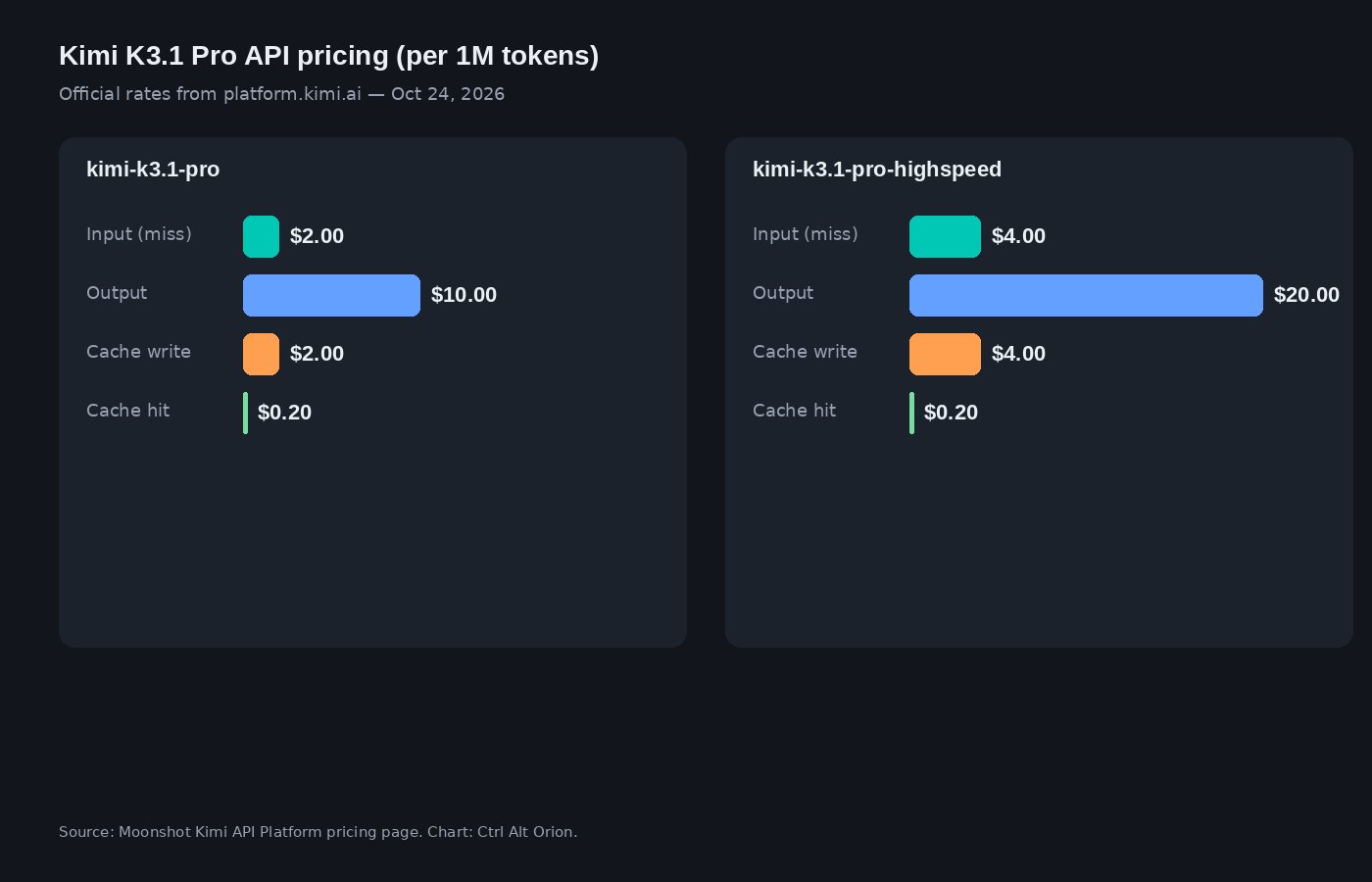 Official per-million rates from platform.kimi.ai. Chart: Ctrl Alt Orion.
For agent loops that re-send the same system prompt and tools every turn, cache hit rate decides whether $2 input feels cheap or whether you burn money on misses and writes. The quickstart’s caching section is worth reading before you point a long-horizon coding agent at kimi-k3.1-pro.
Kimi K3.1 Pro benchmarks: vendor table vs Artificial Analysis
Two scorecards are circulating. They overlap and they disagree. Keep them in separate piles.
Moonshot’s self-reported scores (Kimi blog)
From the official blog (often Claude-Code harness; effort max unless noted):
- Terminal-Bench 4.0: 65.7% — ahead of GPT-6 Astra (58.2%), narrowly behind Claude Opus 5.5 (66.4%) in Moonshot’s table.
- Kimi Code Bench 3.0 Long-horizon (internal): 61.2% vs K3’s 55.95%.
- BenchCAD (with tools): 92.7% (Opus 5.5 96.2%, GPT-6 Astra 95.9% in the same table).
- OfficeQA Pro v2: 64.4 — Moonshot calls this SOTA for complex fiscal docs.
- Kimi Hallu Bench Hard (internal): claim-level hallucination 8.3% vs K3’s 23.4%. Moonshot says this is an adversarial stress set, not a daily error rate.
The Next Web notes those coding figures were not independently checked at publication. Treat them as vendor claims until public weights are re-run outside.
Artificial Analysis (third-party index)
Artificial Analysis’s October 23 article is the main independent index so far:
- Intelligence Index: 55, 4th — behind Claude Opus 5.5 (58), Claude Sonnet 5.5 (56) and Muse Wonder Full (56). Up 11 points from Kimi K3 (44).
- Once weights publish, AA says K3.1 Pro would be the leading open-weights model on that index (gap vs proprietary: 12 → 3 points).
- GDPval-AA: 3rd at 1,846 Elo (+312 vs K3).
- Terminal-Bench 4.0 (AA): 67% — AA’s highest of any model tested; K3 was 13%; Sonnet 5.5 at 64%.
- AutomationBench-AA: 73% (from 58%). Smaller lifts: HLE 47%→52%, CritPt 23%→25%, SciCode 59%→61%; AA-Omniscience 20→30 (hallucination 53%→44%).
Terminal-Bench split: Moonshot 65.7% vs AA 67%. Different harnesses can move a point—quote the source; do not average into a fake “true” score.
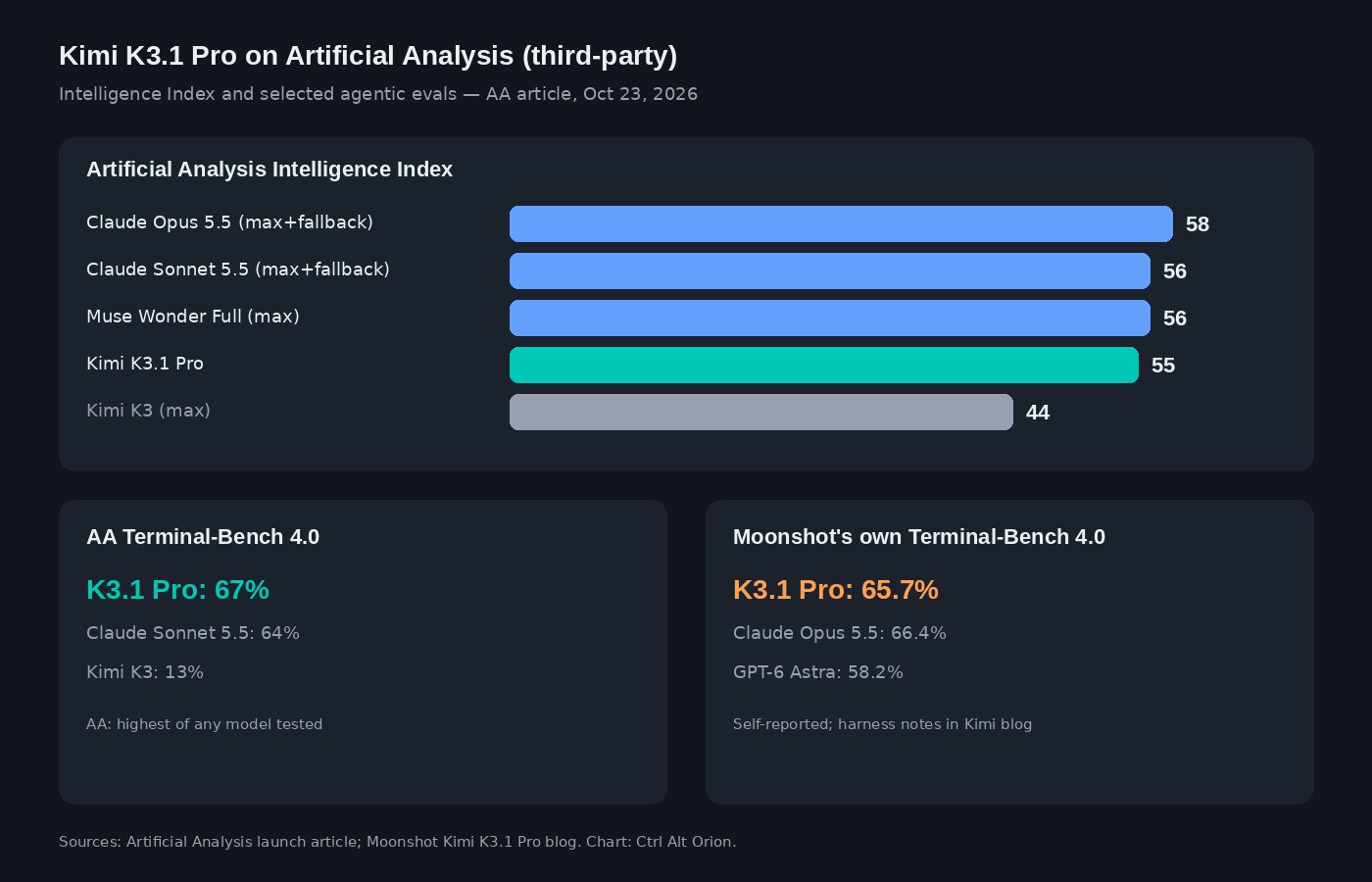 Third-party AA index vs Moonshot’s own Terminal-Bench table. Chart: Ctrl Alt Orion.
Interpretation (ours, labeled): Agentic coding and SaaS automation show the big jump; AA’s classic knowledge/reasoning lifts look more modest. That is common for heavily post-trained agents. It does not prove K3.1 Pro beats Opus 5.5 on your repo—only that public boards put it near the frontier at a lower list price.
Moonshot says it removed cyberattack training data
Moonshot put this in the blog rather than burying it. It says cyber-related content appeared in mid-training data and RL environments as a side effect of broad training, and that leaving it in would have pushed vulnerability-research scores up as post-training scaled. For the open-weight release, it identified and removed cyber-related data from both stages while keeping general coding tasks.
On in-house xdev-bench-hard (sandbox exploit tasks with a secret string for verification):
- Checkpoint without removals: 90.5% pass@3.
- Final K3.1 Pro: 81.0% pass@3.
The Next Web also quotes Moonshot putting K3 at 33.3% and DeepSeek V4.1-Flash at 85.7% on the same style of test—Moonshot’s numbers. Moonshot says K3.1 Pro stays behind frontier proprietary models public ≥3 months, and argues gradual open diffusion helps defenders.
Label carefully: Moonshot’s controls, Moonshot’s bench. Data removal does not freeze the model against later fine-tuning (NextFor flags that). The disclosure matters because open weights cannot be recalled once they ship.
Are Kimi K3.1 open weights on Hugging Face yet?
No. As of October 24, 2026, a kimi k3 huggingface search still lands you on the older Kimi K3 checkpoint, not K3.1 Pro.
- Moonshot’s promise: full weights by November 4, 2026.
- moonshotai on Hugging Face still surfaces Kimi K3 (2.8T-class), not a K3.1 Pro repo.
- Searches for author
moonshotai+K3.1returned no official model. Community placeholders are not Moonshot’s release.
Until November 4 (or whenever files land), “open weight” is a plan, not a download. The K3.1 Pro license is unpublished too—do not pre-commit a self-host architecture on rumors.
Small-shop angle: API now vs waiting for weights
Here is the decision that actually moves a three-person team.
Use the API now if…
- You need coding / research / long-context agents this week.
- You can live with Moonshot hosting (Zero Data Retention is available for API customers, per the blog).
- Your token volume fits a $2 / $10 (or Highspeed $4 / $20) meter with caching tuned.
- You want to A/B against Opus, Argon or Astra without racking hardware.
Rough meter math (not a forecast): $2 input + $10 output → about $3 per 1M in / 100K out before cache. Agents that miss cache and emit long reasoning cost more. Log a week of tokens before calling it cheap.
Wait for weights (Nov 4+) if…
- You need weights on your metal (compliance, air-gap or extreme volume).
- You will not build on a model you cannot pin or inspect.
- You already run multi-GPU MoE inference.
Why it will not run on a single consumer GPU
This is interpretation grounded in the reported size class, not a VRAM bench we ran:
- ~104B active alone sits far above a 24GB card. For scale, our Nemotron 3.5 Bolt on a 24GB GPU guide covers a ~74B-total / ~9B-active MoE that barely fits at 2-bit. K3.1 Pro’s reported active set is far larger.
- ~2.8T total MoE experts are multi-node territory. Meta’s Muse Spark Open already wants two high-end Mac Studios in Meta’s pitch (Muse Spark Open Mac Studio cost). Kimi’s 3T-class story is not friendlier.
- A single RTX 5090-class card is the wrong mental model here. If you eventually self-host, budget for a cluster or rented multi-GPU, not a gaming PC.
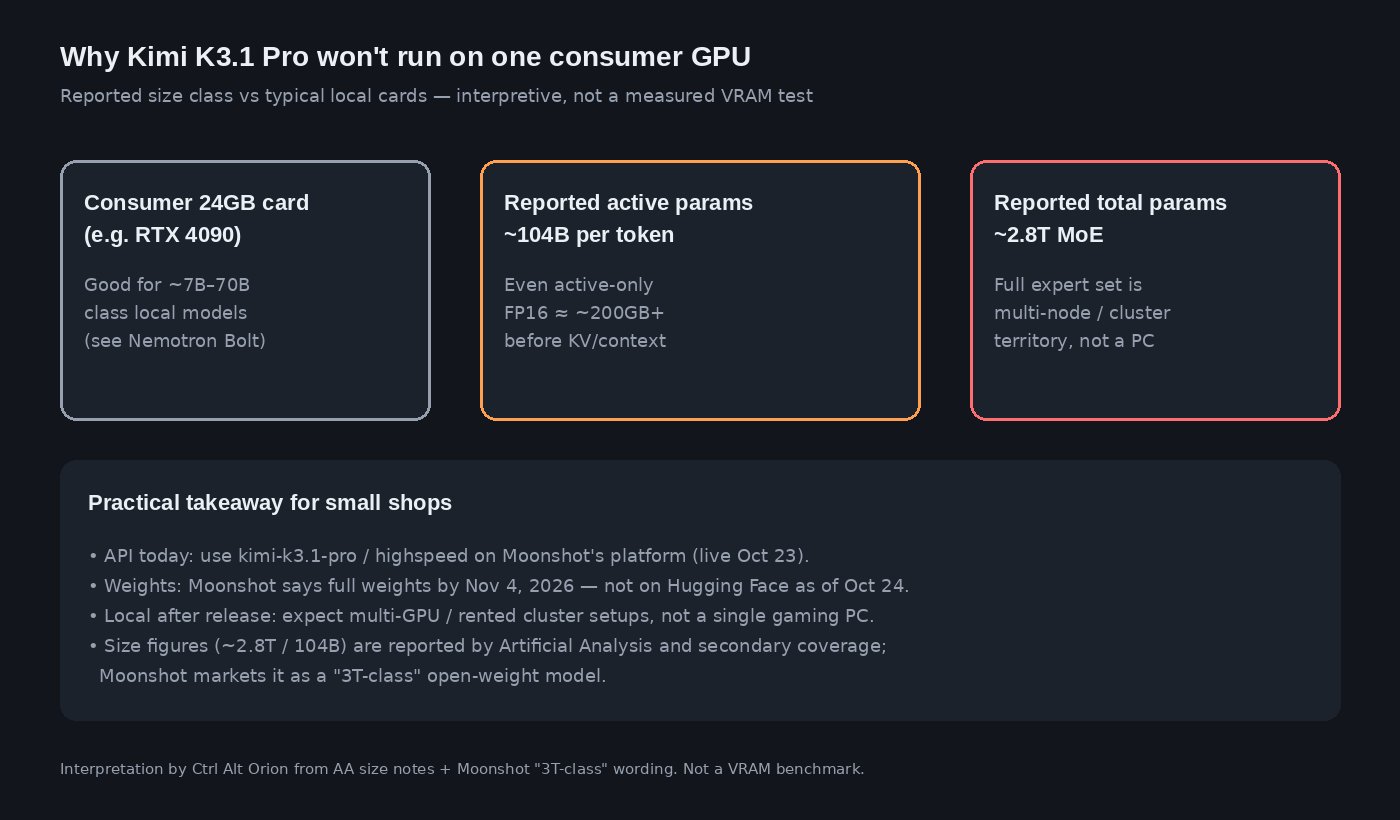 Interpretive size comparison, not a measured footprint. Chart: Ctrl Alt Orion.
If your goal is local inference to keep prompts off a cloud provider’s logs, smaller open models on a card you already own still win on privacy and predictability—see local LLM GPUs vs cloud usage flags. K3.1 Pro’s open-weight promise is about capability and control at the high end, not about replacing a 24GB home box.
How to try it today (API sketch)
From Moonshot’s quickstart: OpenAI-compatible client, base URL https://api.moonshot.ai/v1, model kimi-k3.1-pro or kimi-k3.1-pro-highspeed, key in MOONSHOT_API_KEY. Reasoning effort is top-level (low / high / max); thinking cannot be turned off. Return the full assistant message on multi-turn and tool loops. max_completion_tokens defaults to 131,072 (max 1,048,576). Sampling knobs are fixed server-side—omit them. Docs cover streaming, vision, structured output and Formula tools.
What to watch on November 4
- Official
moonshotaiHugging Face (or equivalent) repo, quants and whether GGUF / MLX appear day one. - License terms—restrictive commercial strings change the product.
- Independent Terminal-Bench / AA re-runs on the published checkpoint (does 67% vs 65.7% converge?).
- Whether cyber filtering survives fine-tuning.
- Highspeed vs Pro latency on your tasks (2–3× is still a vendor claim until you measure).
Our take
Kimi K3.1 Pro is a serious API competitor today: 1M context, $2 / $10 with a $0.20 cache hit, and Artificial Analysis ranking it fourth on the Intelligence Index with a large agentic jump over K3. Open weights are a calendar event, not a download. Moonshot’s cyber-data cut is unusually explicit—take the disclosure seriously and still wait for outside audits. For a small shop: meter the API this week, keep replayable evals, and only plan local hardware after November 4 files, license and VRAM recipes exist. Do not buy a single consumer GPU “for Kimi K3.1.
FAQ
When did Kimi K3.1 Pro launch?
Moonshot introduced it on October 23, 2026. Apps and the API were available the same day; full weights are promised later.
What is Kimi K3.1 Pro pricing?
On platform.kimi.ai, Pro is $2.00 input, $10.00 output, $2.00 cache write and $0.20 cache hit per million tokens. Highspeed is $4 / $20 / $4 / $0.20. Flat rates; no context-length price tiers.
What are the main Kimi K3.1 Pro benchmarks?
Vendor: Terminal-Bench 4.0 65.7%, BenchCAD 92.7%, OfficeQA Pro v2 64.4, internal long-horizon 61.2%. Artificial Analysis: Intelligence Index 55 (4th), Terminal-Bench 4.0 67%, GDPval-AA 1,846 Elo, AutomationBench-AA 73%. Cite which table you quote.
When do Kimi K3.1 open weights ship?
Moonshot says by November 4, 2026. As of October 24 they are not published.
Is Kimi K3.1 Pro on Hugging Face?
Not the official weights. Moonshot’s org still shows Kimi K3. Ignore unofficial mirrors until moonshotai publishes K3.1 Pro.
Can I run Kimi K3.1 Pro on one consumer GPU?
Practically no, given the reported ~2.8T / ~104B class. Expect multi-GPU or rented clusters after weights drop—not a 24GB gaming card.
Did Moonshot remove hacking training data?
Moonshot says it removed cyber-related data from mid-training and RL for the open release, dropping its in-house xdev-bench-hard score from 90.5% to 81.0% pass@3. That is a self-reported control, not an outside audit.
What is the difference between Pro and Highspeed?
Same model family and 1M context, per Moonshot. Highspeed is marketed at roughly 2–3× speed and billed at 2× on input, output and cache write; cache hits stay $0.20.
Sources
8 refs- Moonshot / Kimi, “Introducing Kimi K3.1 Pro” (blog): https://www.kimi.ai/blog/kimi-k3-1-prokimi.ai
- Kimi API Platform, “Kimi K3.1 Pro” quickstart: https://platform.kimi.ai/docs/guide/kimi-k3-1-pro-quickstartplatform.kimi.ai
- Kimi API Platform, pricing (home): https://platform.kimi.ai/platform.kimi.ai
- Artificial Analysis, “Kimi K3.1 Pro launch benchmarks” (October 23, 2026): https://artificialanalysis.ai/articles/kimi-k3-1-pro-launch-benchmarksartificialanalysis.ai
- The Next Web, “Moonshot releases Kimi K3.1 Pro and says it cut its hacking skills” (October 23, 2026): https://thenextweb.com/news/moonshot-kimi-k3-1-pro-open-weight-cyberthenextweb.com
- NextFor, “Moonshot Ships Kimi K3.1 Pro Today, With Open Weights Due by November 4”: https://www.nextfor.ai/news/kimi-k31-pro-open-weightnextfor.ai
- Simon Willison, “Introducing Kimi K3.1 Pro” (October 23, 2026): https://simonwillison.net/2026/Oct/23/kimi-k31-pro/simonwillison.net
- Hugging Face, Moonshot AI org (checked October 24, 2026): https://huggingface.co/moonshotaihuggingface.co
comments
loading comments…
No comments yet. Start the thread.