
Header image: a developer working on a laptop at night. Photo: Chirayu Trivedi on Unsplash.
Note: Google released Gemini 4 Argon globally on October 13, 2026, one day before this was written. Prices were checked on Google’s Gemini API pricing page and the Gemini 4 Argon developer guide on October 14, 2026. The introductory price ends November 30, 2026, so the math below has a seven-week shelf life on the cheap side and applies from December 1 onward on the expensive side.
Gemini 4 Argon pricing has an end date on it. Google’s new flagship model costs $2 per million input tokens and $10 per million output tokens through November 30. On December 1 it goes to $4 and $20 (Google). Same model, same API, double the bill.
For a big company that’s a line item. For a three-person dev shop it’s the difference between “the coding agent costs about as much as a dev tool subscription” and “the coding agent is now a real budget conversation.” It also means that any workflow you build in the next seven weeks will be judged on its cost at the old price and paid for at the new one.
This piece does the math. Below are worked monthly costs for three workloads a small shop actually runs, at both prices, with every multiplication shown. Then a comparison against Claude Opus 5.5, Claude Fable 5.1 and GPT-6 Astra, an honest look at the benchmarks, and a short list of what to set up before December 1 so the doubling shows up in a dashboard and not in an invoice.
Gemini 4 Argon pricing: the short version
- Through November 30, 2026: $2 per 1M input tokens, $10 per 1M output tokens, $0.10 per 1M cached input tokens.
- From December 1, 2026: $4 input, $20 output, $0.20 cached input.
- Output includes thinking tokens. Every token the model spends reasoning is billed at the output rate.
- Caching is implicit only. Google doesn’t support explicit caching on Argon; cache hits are discounted 95% automatically on prompts of at least 4,096 tokens.
- Batch is half price: $1 and $5 through November 30, $2 and $10 after.
- Not on the free tier, and not on the Google AI Pro plan. You need the paid API tier.
All of that is from Google’s pricing page and the Argon developer guide (Google pricing, Google developer guide).
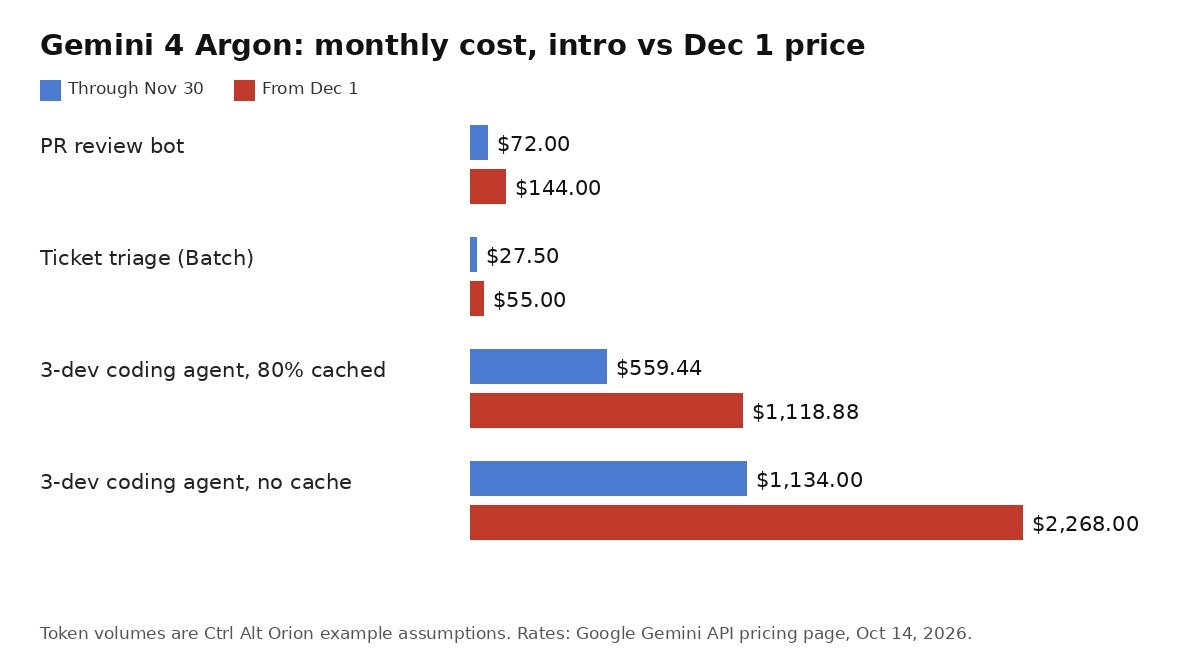 Every workload doubles on December 1; caching is the only lever that cuts the coding-agent bill in half. Chart: Ctrl Alt Orion, from Google’s published rates.
What Google actually launched
Google announced on October 13 that Gemini 4 Argon is globally available to developers and enterprises through the API in AI Studio and the Gemini platform, to Google AI Ultra subscribers in Google Antigravity, and to Ultra and Pro subscribers in the Gemini app and AI Mode in Search (Google). The Decoder notes that free Gemini users and Plus subscribers only get the Flash models under Google’s new tier structure, and that Argon replaces the Pro class as Google’s frontier series (The Decoder).
A small wrinkle worth knowing: Google’s developer docs say Argon “is not available on the Free tier or on the Google AI Pro plan,” while the launch blog says Pro subscribers can use it in the Gemini app and AI Mode. Read together, a Pro subscription gets you Argon in the consumer app, not in the developer API. If you want to call it from code, you need paid API billing.
The technical details that move your bill, from the developer guide:
- Model ID:
gemini-4-argon, default thinking levelmedium. - One shared 1M-token window for input, thinking and output (1,048,576 tokens).
- Long decode: a single response can run past 64K tokens, up to 1M minus your input, using background execution.
- Thinking levels:
low,mediumandhigh. Google says Argon “can spend more of the limit on thinking than earlier models” and recommends raisingmax_output_tokensto at least 32,768 for existing apps. - No sampling parameters:
temperature,top_pandtop_kare ignored. - Explicit caching removed: calls that create or reference
cached_contentneed to go.
That last pair matters for migration. If your current Gemini integration uses explicit context caching to keep costs down, that code path doesn’t exist on Argon. You’ll be relying on implicit caching, which you don’t control directly.
The full Argon price table
| Rate (per 1M tokens) | Through Nov 30, 2026 | From Dec 1, 2026 |
|---|---|---|
| Input, Standard | $2.00 | $4.00 |
| Output incl. thinking, Standard | $10.00 | $20.00 |
| Cached input (implicit) | $0.10 | $0.20 |
| Input, Batch or Flex | $1.00 | $2.00 |
| Output, Batch or Flex | $5.00 | $10.00 |
| Input, Priority | $3.60 | $7.20 |
| Output, Priority | $18.00 | $36.00 |
Source: Google’s Gemini API pricing page, last updated October 14, 2026. Grounding with Google Search is extra: 5,000 free requests a month shared across Gemini 3 and newer models, then $14 per 1,000 requests.
Google’s blog footnote says the $4 and $20 price applies after the introductory period ends on November 30, 2026, to “the Argon model intended for public access” (Google).
What it costs a small dev shop: three worked examples
The rates are facts. The token volumes below are our assumptions, chosen to look like real small-shop usage. Swap in your own numbers; the method is the point. Formula throughout:
(input millions × input rate) + (cached millions × cache rate) + (output millions × output rate)
1. A pull-request review bot
A bot that reads each PR with surrounding files and writes a review.
- 400 PRs a month × 60,000 input tokens = 24M input tokens
- 400 PRs × 6,000 output tokens (review plus thinking) = 2.4M output tokens
| Through Nov 30 | From Dec 1 | |
|---|---|---|
| Input | 24 × $2 = $48 | 24 × $4 = $96 |
| Output | 2.4 × $10 = $24 | 2.4 × $20 = $48 |
| Monthly total | $72 | $144 |
If half of that input hits the implicit cache (shared repo context, same system prompt), the intro bill is 12 × $2 + 12 × $0.10 + 2.4 × $10 = $24 + $1.20 + $24 = $49.20, and the December bill is 12 × $4 + 12 × $0.20 + 2.4 × $20 = $48 + $2.40 + $48 = $98.40.
Verdict: cheap either way. This is not the workload to lose sleep over.
2. Support-ticket triage on the Batch API
Summarize and tag every incoming ticket overnight. Nobody needs the answer in real time, so it goes through Batch at half price.
- 5,000 tickets × 3,000 input tokens = 15M input tokens
- 5,000 tickets × 500 output tokens = 2.5M output tokens
| Through Nov 30 (Batch) | From Dec 1 (Batch) | |
|---|---|---|
| Input | 15 × $1 = $15 | 15 × $2 = $30 |
| Output | 2.5 × $5 = $12.50 | 2.5 × $10 = $25 |
| Monthly total | $27.50 | $55 |
On Standard instead of Batch, the same job would be $55 now and $110 after December 1. Batch saves more than the intro pricing does here.
3. A coding agent for three developers
This is the one that matters. Agentic coding re-sends large chunks of context on every turn, and thinking tokens are billed as output.
- 3 developers × 20 agent sessions a workday × 21 workdays = 1,260 sessions a month
- 1,260 × 300,000 input tokens per session (accumulated across turns) = 378M input tokens
- 1,260 × 30,000 output tokens per session = 37.8M output tokens
No caching:
| Through Nov 30 | From Dec 1 | |
|---|---|---|
| Input | 378 × $2 = $756 | 378 × $4 = $1,512 |
| Output | 37.8 × $10 = $378 | 37.8 × $20 = $756 |
| Monthly total | $1,134 | $2,268 |
With 80% of input hitting the implicit cache (302.4M cached, 75.6M uncached):
| Through Nov 30 | From Dec 1 | |
|---|---|---|
| Uncached input | 75.6 × $2 = $151.20 | 75.6 × $4 = $302.40 |
| Cached input | 302.4 × $0.10 = $30.24 | 302.4 × $0.20 = $60.48 |
| Output | 37.8 × $10 = $378 | 37.8 × $20 = $756 |
| Monthly total | $559.44 | $1,118.88 |
Two things fall out of that table. First, once caching works, output is most of the bill: $756 of the $1,118.88 December total. Thinking level is therefore your biggest cost lever, more than input size. Second, an agent that costs about $560 a month in October costs about $1,120 in December without anyone touching the code. Over a year at the regular price, that’s $13,426.56 for one three-person team.
The 80% cache-hit figure is an assumption, not a Google number. Implicit caching only applies to prompts of at least 4,096 tokens, and you can’t force a hit. Measure your own hit rate in the first week.
Gemini 4 Argon vs Opus 5.5, Fable 5.1 and GPT-6 Astra
The Decoder published a side-by-side price table at launch (The Decoder):
| Per 1M tokens | Argon (intro) | Argon (regular) | GPT-6 Astra | Claude Fable 5.1 | Claude Opus 5.5 |
|---|---|---|---|---|---|
| Input | $2 | $4 | $10 | $10 | $4 |
| Output | $10 | $20 | $50 | $50 | $20 |
| Cache reads | $0.10 | $0.20 | $1 | $0.25 | $0.20 |
| Cache writes | N/A | N/A | $12.50 | $12.50 (5 min) / $20 (1 hr) | $5 (5 min) / $8 (1 hr) |
The Decoder notes Google doesn’t state the cache-read figure directly, only the 95% discount; Google’s own pricing page now lists $0.10 and $0.20, which matches.
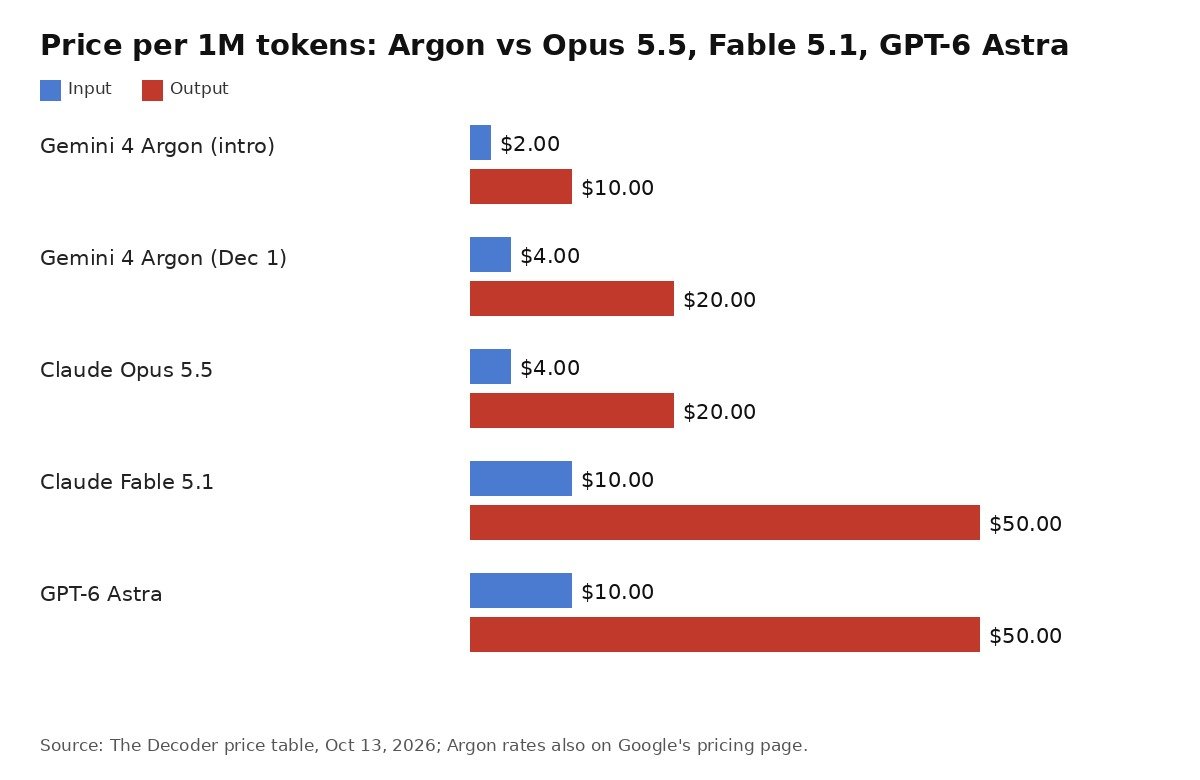 After December 1, Argon’s list price matches Opus 5.5 exactly. Chart: Ctrl Alt Orion, from The Decoder’s table and Google’s pricing page.
The headline: on December 1, Argon costs exactly what Claude Opus 5.5 costs, $4 in and $20 out. The intro price is a seven-week head start, not a permanent advantage. Fable 5.1 and GPT-6 Astra are both 2.5× Argon’s regular rate.
Here’s the coding-agent workload from above, run through each model’s published rates with 80% cache hits:
| Model | Uncached input | Cache reads | Output | Monthly total |
|---|---|---|---|---|
| Argon (intro) | $151.20 | $30.24 | $378 | $559.44 |
| Argon (Dec 1) | $302.40 | $60.48 | $756 | $1,118.88 |
| Claude Opus 5.5 | 75.6 × $4 = $302.40 | 302.4 × $0.20 = $60.48 | 37.8 × $20 = $756 | $1,118.88 + cache writes |
| Claude Fable 5.1 | 75.6 × $10 = $756 | 302.4 × $0.25 = $75.60 | 37.8 × $50 = $1,890 | $2,721.60 + cache writes |
| GPT-6 Astra | 75.6 × $10 = $756 | 302.4 × $1 = $302.40 | 37.8 × $50 = $1,890 | $2,948.40 + cache writes |
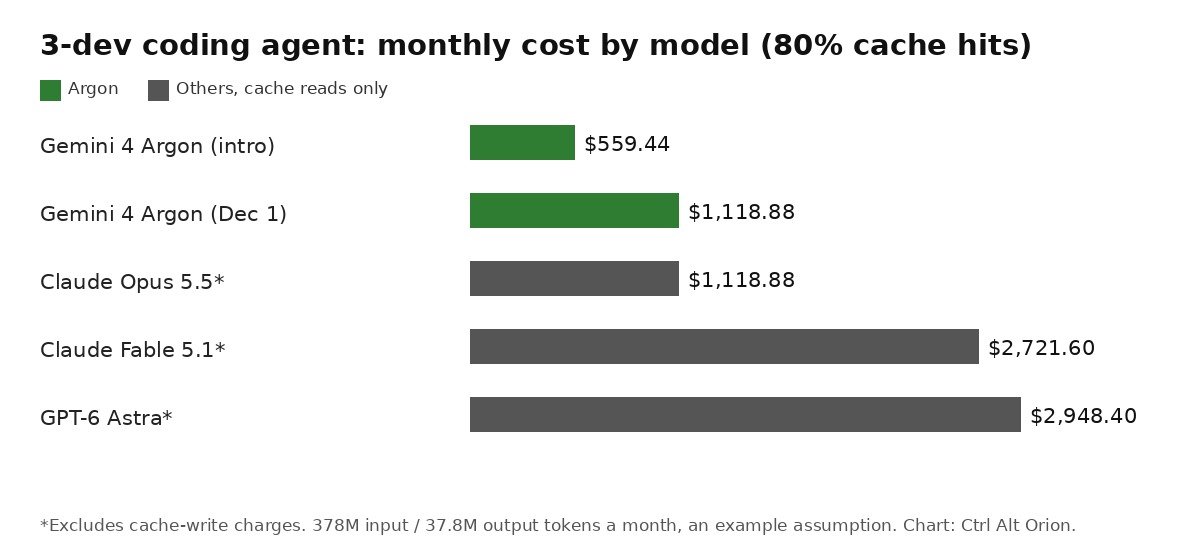 Argon and Opus 5.5 tie at list price; Argon has no published cache-write charge. Chart: Ctrl Alt Orion.
The non-Google totals leave out cache writes, because the volume depends on how often each provider’s cache expires, which we can’t know for your workload. They’re a floor, not an estimate. Argon has an edge here that the headline rates hide: The Decoder’s table lists no cache-write charge for it, and Google’s page shows none, while Opus 5.5 charges $5 to $8 per million tokens written to cache. The trade-off is control. Anthropic and OpenAI let you decide what gets cached; Argon’s caching is implicit and automatic.
One more caveat that applies to every row: different models use different numbers of tokens for the same task, especially thinking tokens. A model that’s cheaper per token but thinks twice as long isn’t cheaper. The only way to know is to run your own workload through each and read the usage numbers.
For a deeper look at how Anthropic’s cache pricing plays out for a small team, see our Claude Fable 5.1 cache pricing breakdown.
Gemini 4 Argon benchmarks: what’s actually published
Only numbers a source actually printed:
- Vals Index: Google says Argon ranks #1 on the Vals Index, which covers finance, coding, legal and tax work (Google).
- ERQA (Embodied Reasoning): 87%, which Google says beats all other frontier models.
- Gray Swan Indirect Prompt Injection: 0.7% successful attack rate across 15 adaptive attempts. The Decoder points out that GPT-6 Astra scored 8.5% and Claude Opus 5 scored 4.8% on an earlier Gray Swan test, but that it’s not clear the tests were identical.
- RareBench 57% and LabBench 52.2%: these are private evaluations by Gamow Labs, derived from their own clinical and lab data, not public leaderboards.
- Google’s internal numbers: more than 35% more agent-driven code submissions and nearly a third fewer rollbacks. Self-reported.
And the counterweight: The Decoder reports that Argon “still trails Anthropic’s Claude Opus 5.5 in independent overall rankings,” and now also sits behind Meta’s Muse Wonder Full, which launched the day before (The Decoder).
So the honest framing for gemini 4 argon vs opus 5.5 is: same regular price, Argon is slightly behind on independent overall rankings, Argon is cheaper for the next seven weeks, and Argon has no cache-write charge. None of that tells you which one writes better code in your repo. Your own eval does.
When to lock in a workflow now, and when to wait
Build on Argon now if:
- You were going to pay Opus 5.5 prices anyway. At regular rates they’re identical, so the intro period is seven weeks of half-price evaluation with no long-term downside.
- Your workload is batchable. Batch at $1 and $5 now, $2 and $10 later, is cheaper than Standard Opus 5.5 at any point.
- You need the 1M shared window or long decode for big refactors or long reports.
- You’re currently on Fable 5.1 or GPT-6 Astra and price is the problem. Argon’s regular rate is 40% of theirs.
Wait, or don’t build around Argon, if:
- Your cost case only works at $2 and $10. If the project is marginal at the intro price, it will fail at double. Model it at $4 and $20 before you write any code.
- You depend on explicit caching to make the numbers work. That’s gone on Argon.
- You need the model that currently ranks best overall. By The Decoder’s account, that’s not Argon today.
- Google has said more Gemini 4 models are coming. If a cheaper Gemini 4 Flash variant would do the job, waiting may save more than the intro discount does. We don’t have a date or price for one.
The rule we’d use: set your go/no-go decision on the December price, and treat the next seven weeks as a discount on testing. We made the same argument about promo pricing generally in Your API Bill Has an Expiration Date.
How not to get surprised on December 1
1. Put the date in two places. A calendar reminder for November 24 to review usage, and a note in whatever doc tracks your vendor costs. The price change doesn’t need you to do anything, which is exactly why it gets missed.
2. Budget at the December price from day one. If you track spend per feature, record the projected cost at $4 and $20 next to the actual. The gap is the number your finance person needs to see before December, not after.
3. Set a hard ceiling on output. max_output_tokens caps thinking plus output per response. Google recommends 32,768 or more for existing apps and up to 262,144 for complex work. Pick the lowest value your evals pass with, and test thinking_level at low, medium and high as Google suggests. Output is where most of the coding-agent bill goes.
4. Measure your cache hit rate, then design for it. Caching only kicks in at 4,096 tokens or more, and you can’t force it. Keep the stable parts of the prompt (system prompt, repo map, style rules) at the front and unchanged between calls so they’re more likely to be reused. Check cached token counts in the usage data in week one.
5. Move everything non-interactive to Batch. Nightly summaries, test-failure triage, doc generation. Half price at both rates.
6. Route by difficulty. Not every call needs the flagship. A cheaper model for easy calls and Argon only for hard ones changes the bill more than any discount. Our two-tier model router guide shows how to set that up on a small budget.
7. Track spend yourself. Tool dashboards don’t always show what you’re paying per model. We covered why and how to build your own in Cursor Hid the Price: Track Your AI Spend Yourself.
When this doesn’t apply
If your team uses Argon only through the Gemini app on an Ultra or Pro subscription, none of the per-token math applies; you’re on a flat subscription. If you’re an enterprise buying through Google’s enterprise platform, Google’s pricing page says prices there may differ from the developer API prices above. And if your monthly token volume is closer to the PR-bot example than the coding-agent one, the doubling is a rounding error. Spend the time on something else.
Using Argon through GitHub Copilot instead of the API
GitHub made Gemini 4 Argon generally available in Copilot on October 13, for Copilot Pro+, Max, Business and Enterprise users. It isn’t listed for Copilot Free or plain Copilot Pro. You pick it in the model picker in VS Code, Visual Studio, JetBrains IDEs, Xcode, Eclipse, Copilot CLI, the Copilot app and the Copilot coding agent (GitHub).
Don’t treat Copilot as a way around the December doubling. GitHub says Argon “is billed at provider list pricing under usage-based billing,” so you pay Google’s list rates either way, just on your GitHub bill. What Copilot does save a small shop is plumbing. You don’t need a Google Cloud billing account or API keys, or any code to write, and Business and Enterprise admins can turn the model on or off through Copilot’s model policy. If Argon is only for your developers’ editors and terminals, Copilot is probably the simpler buy.
The API still makes sense for anything that runs without a person in an editor. That covers the PR bot, the nightly ticket triage and your own app’s features. It’s also the only route to the Batch and Flex tiers at half price, and the only place you control thinking_level and max_output_tokens per call, which are the two biggest cost levers in this article.
FAQ
How much does Gemini 4 Argon cost?
Through November 30, 2026: $2 per 1M input tokens and $10 per 1M output tokens, with cached input at $0.10. From December 1, 2026: $4 input, $20 output, $0.20 cached input. Output includes thinking tokens. The Batch API and Flex tier are half the Standard price: $1 and $5 now, $2 and $10 from December 1.
When does the Gemini 4 Argon price increase?
December 1, 2026. Google’s pricing page lists the introductory rates “through November 30, 2026” and the higher rates “starting December 1, 2026.”
How do I get Gemini 4 Argon API access, and is it free?
It’s not free. Argon isn’t available on the Gemini API free tier or on the Google AI Pro plan for API use, so you need paid API billing; the model ID is gemini-4-argon. Google AI Ultra and Pro subscribers can use it in the Gemini app and AI Mode in Search. Caching on the API is implicit only: it’s on by default for prompts of at least 4,096 tokens and discounts cached input by 95%, and existing cached_content calls must be removed.
Gemini 4 Argon vs Opus 5.5: which is cheaper?
Until November 30, Argon is half the price. From December 1, the list prices are identical at $4 input and $20 output, per The Decoder’s comparison table. Argon has no published cache-write charge; Opus 5.5 charges $5 to $8 per million tokens written.
What Gemini 4 Argon benchmarks has Google published?
Google says Argon is #1 on the Vals Index, scores 87% on ERQA and has a 0.7% attack success rate on Gray Swan’s indirect prompt injection test. The Decoder reports it still trails Claude Opus 5.5 in independent overall rankings.
Does using Gemini 4 Argon through GitHub Copilot avoid the December 1 price increase?
No. GitHub says Argon in Copilot “is billed at provider list pricing under usage-based billing,” so you pay Google’s list rates either way, including the December 1 doubling, just on your GitHub bill.
Sources
5 refs- Gemini Developer API pricing — Google, last updated October 14, 2026ai.google.dev
- What’s new in Gemini 4 Argon — Google AI for Developers, last updated October 13, 2026ai.google.dev
- Gemini 4 Argon: Built to solve your hardest problems — Google, October 13, 2026blog.google
- Gemini 4 Argon is now available worldwide as Google’s most capable frontier model — The Decoder, October 13, 2026the-decoder.com
- Gemini 4 Argon in GitHub Copilot — GitHub Changelog, October 13, 2026github.blog
comments
loading comments…
No comments yet. Start the thread.