Disclosure: some links below are Amazon affiliate links (tag cao04-20). Costs you nothing; the picks don’t change based on that. Every spec and price below is sourced at the bottom.
Note: All pricing here is as of September 28, 2026, and in this market that expiration date is real — GPU prices have been moving on a weekly basis all quarter, not a seasonal one. Check the live number before you commit; the ranking below is more durable than any figure in it.
You had a plan. It was a good plan. You were going to spend two thousand dollars on a graphics card, put it in a box in the closet, and stop paying per token for the boring half of your automation — the summarizing, the classifying, the reformatting, the six hundred little jobs a day that don’t need a frontier model and shouldn’t cost frontier money.
Then you went to buy the card.
The RTX 5090 launched at a $1,999 MSRP. As of September 28, 2026, the price tracker cited at the bottom of this piece lists it at $6,995.95 at Amazon — about 3.5x MSRP, which the tracker renders as 250% above it. The same tracker’s observed range since it began following the card in June 2026 runs from a low of $4,199.99 (July 30, 2026) to a high of $7,369.90 (September 12, 2026), with used cards on eBay around $6,000.
Four numbers for one card, and that spread is the actual finding. There is no price for the 5090 right now, only a band — and the bottom of the band, on the best day the tracker has recorded all year, is still 2.1x MSRP. Every figure in this piece is dated and attributed in the price provenance table below, because in this market an undated number is a lie with a delay on it.
That is not a scalping story you can wait out over a long weekend. It’s a supply story with a multi-year shape to it, and it changes the answer to “what should I buy,” not just “when should I buy.”
So: here is what to buy instead, ordered by the only metric that actually decides whether a local model is useful to you — dollars per gigabyte of memory the model can live in — with the honest caveats about what you give up, and a section at the end arguing that a meaningful share of readers should buy nothing at all.
Why the 5090 isn’t going back to $1,999, and why that’s not Nvidia being greedy
It’s memory.
The AI buildout consumed the world’s memory supply. Samsung, SK Hynix, and Micron shifted cleanroom capacity toward high-bandwidth memory for datacenter accelerators, because that’s where the margin is, and every wafer that becomes an HBM stack is a wafer that doesn’t become the DRAM on a consumer graphics card or the LPDDR in a laptop. In current conditions, memory reportedly accounts for more than 80% of the bill of materials on some high-end cards — a figure that circulates in trade coverage rather than in any vendor’s audited disclosure, so treat it as the right order of magnitude and not a number to quote in a board meeting. It means a graphics card is now mostly a memory product with a compute die attached, and it gets priced like one.
The knock-on effects are everywhere in the numbers. IDC cut its 2026 PC shipment forecast on memory shortages while simultaneously raising its total market value forecast to $274 billion, because unit sales are falling and prices are climbing faster. Amazon raised prices on its own hardware by as much as 60% in August and said memory out loud as the reason. Micron’s CEO has said he expects the shortage to persist through 2027; SK Hynix has described 2027 as potentially the worst year for supply.
Two practical conclusions fall out of that:
- Waiting is not a strategy with a defined end date. “Prices come back next spring” is not what any of the suppliers are saying.
- Anything memory-dense is expensive, and anything that gets you memory cheaply is suddenly the smart buy — even if it’s slow, even if it’s used, even if it’s an unfashionable form factor.
That second point is the whole piece. We covered the consumer-side version of this in the memory price shock piece; this is the inference-hardware version.
First, the boring question nobody asks before spending $2,000: how big is your model, really?
Most small-shop local-AI plans die of a mismatch between the model people imagine running and the job they actually have. So before any product talk:
| Model class | Roughly needs (4-bit) | What it’s actually good for in a shop |
|---|---|---|
| 7B–8B | 6–8 GB | Classification, extraction, tagging, routing, short rewrites |
| 13B–14B | 10–12 GB | The above, with noticeably fewer dumb mistakes |
| 27B–32B | 20–24 GB | Summarizing long documents, decent drafting, light reasoning |
| 70B | 40–48 GB | Work you’d otherwise send to a mid-tier API model |
| 120B+ / MoE 200B+ | 70–140 GB+ | Ambition, mostly — and occasionally a real reason |
Here’s the uncomfortable truth for the 5090 plan specifically: 32GB of very fast VRAM is a strange place to land. It’s more than you need for the 7B-to-32B band that covers most real small-shop automation, and not enough for the 70B-and-up band where a local model starts genuinely substituting for a paid API. You were about to pay a scarcity premium of somewhere between 2.1x and 3.5x MSRP — depending entirely on which week you hit checkout — for a capacity tier that sits in a gap.
That reframing is what makes the alternatives below better buys rather than consolation prizes.
Pick 1: A 128GB unified-memory mini workstation (Ryzen AI Max+ 395)
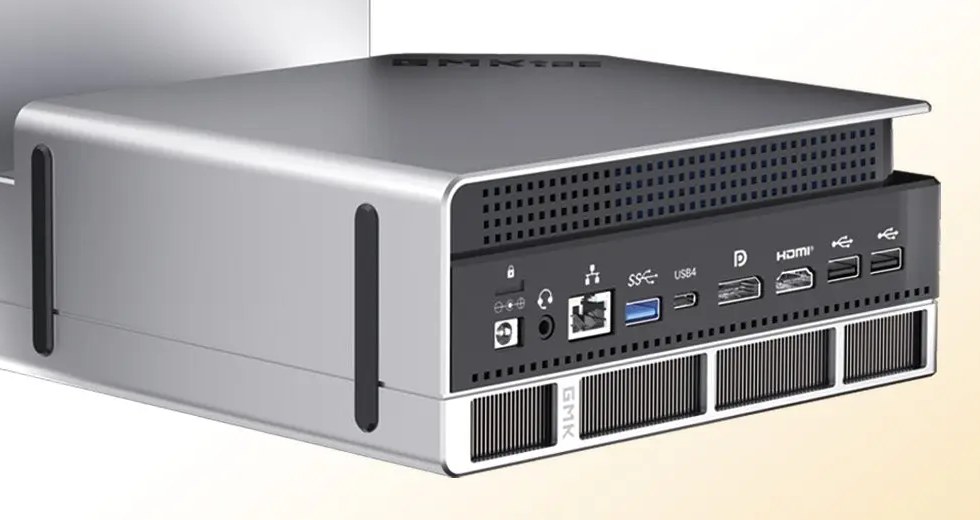
Check current pricing on the GMKtec EVO-X2 with Ryzen AI Max+ 395 and 128GB
This is the pick, and the reason is one sentence: it is the cheapest legitimate route to more than 100GB of memory a model can actually occupy, and in a market where memory is the scarce good, that is the whole ballgame.
The chip is AMD’s Ryzen AI Max+ 395 — 16 cores and 32 threads up to 5.1GHz, a 40-compute-unit Radeon 8060S integrated GPU on RDNA 3.5, and an XDNA 2 NPU rated at 50 TOPS with 126 TOPS claimed platform-wide. The important part isn’t any of those numbers. It’s the memory architecture: LPDDR5X-8000, up to 128GB, shared between CPU and integrated GPU. A large share of that pool can be handed to the graphics side, which means a 70B model at 4-bit fits in memory without any of the layer-splitting gymnastics a 24GB discrete card requires.
GMKtec’s EVO-X2 specifics, from the manufacturer’s own product page:
| Spec | EVO-X2 |
|---|---|
| CPU | Ryzen AI Max+ 395, 16C/32T, up to 5.1 GHz |
| iGPU | Radeon 8060S, 40 CU, RDNA 3.5 |
| NPU | XDNA 2, 50 TOPS (126 TOPS platform) |
| Memory | LPDDR5X-8000, 64GB or 128GB — soldered, not upgradeable |
| Storage | Dual M.2 2280 PCIe 4.0, up to 16TB total |
| Networking | 2.5GbE, Wi-Fi 7 |
| Ports | 2× USB4, 3× USB-A 3.2 Gen2, 2× USB-A 2.0, HDMI 2.1, DP 1.4, SD 4.0 |
| Power | 120W typical, ~140W peak, 230W adapter |
| Size | 193 × 185.8 × 77 mm |
| OS | Windows 11 Pro |
Price reality check. GMKtec’s direct price for 128GB/2TB has been $2,199, and Micro Center has listed a 128GB/2TB configuration at $2,299. Amazon pricing on this machine is volatile — trackers show a low around $2,199, an average near $2,921, and a late-September US listing as high as $3,649.99. Do not buy it at $3,649 without checking the manufacturer’s direct price the same afternoon. At $2,200–2,500 it is the best memory-per-dollar buy in consumer hardware right now. At $3,600 it is merely fine.
The honest downside, stated plainly: you are buying capacity, not speed. Unified LPDDR5X does not have anything like the bandwidth of a discrete card’s dedicated memory, and local LLM generation speed is overwhelmingly a bandwidth problem. Vendor-adjacent testing has reported a very large MoE model (Qwen3 235B) running on the 128GB configuration at around 11 tokens per second — which is genuinely remarkable for the price and the power envelope, and is also slower than you read. Treat all such figures as directional until you’ve run your own prompt on your own machine.
Which means the fit is specific: this is a batch machine, not a chat machine. Overnight document processing, queue work, classification runs, the nightly pass over the day’s tickets — jobs where throughput per dollar matters and nobody is sitting there watching the cursor. If your use case is a person typing at it and waiting, you will find 11 tokens/second maddening, and you should look at pick 2 or 3 with a smaller model instead.
Worth knowing: this isn’t a one-vendor market. TechRadar counted 37 different Ryzen AI Max+ 395 mini PCs on sale, starting around $1,500 for lower-memory configurations. Framework’s Desktop starts at $1,639 with the same chip and 64GB. Shop the platform, not the brand — and if you want the always-on-agent framing for what to do with the box once it’s on your desk, we wrote that up in the always-on local agent piece.
Pick 2: A used RTX 3090 (24GB) — still the VRAM value king, but the window is closing
Check current RTX 3090 24GB pricing and listings
The 2020-vintage RTX 3090 packs 24GB of GDDR6X, and on the used market it remains the cheapest path to that much genuinely fast memory by a wide margin. Reported performance in the band that matters: a 32B model at 4-bit at roughly 37 tokens per second — which is a usable, interactive, somebody-is-waiting-for-this speed, and about 3x the batch-machine figure above.
The problem is that everybody figured this out. Used 3090s trading at $650 to $750 in early 2026 now average around $1,000 on eBay, with a wider observed range of roughly $820 to $1,900 depending on condition. One tracker put the used figure at $1,413 in September 2026. The arbitrage is being closed in real time by other people reading the same math.
Buy this if: you want interactive speed on models up to about 32B, you’re comfortable buying used compute, and you can get one under roughly $1,100.
Don’t buy this if: you need more than 24GB (two of them is a real build, but now you’re specifying a 1000W+ power supply, a case with actual airflow, and a level of project appetite most shops don’t have), or if a dead card with no warranty would be a genuine problem rather than an annoyance. It’s a six-year-old 350W part that may have spent three of those years mining.
Pick 3: RTX 5060 Ti 16GB — the sane, boring, still-buyable-at-retail option
Check current RTX 5060 Ti 16GB pricing
If the honest scope of your local-AI plan is “7B to 13B models doing narrow jobs, running all the time, in a machine I already own,” this is the card, and everything above is overkill.
Pricing has been in the $499 new / $410 used range on GPU price trackers, though Amazon listings around $679.99 have also been observed this month — the spread between trackers and live retail is itself a symptom of the shortage. 16GB is enough for a 13B model at 4-bit with room for context, and it does it inside a power envelope that won’t force you to rethink your UPS.
Note the adjacency, because we don’t want to pretend it isn’t there: we already recommended a 16GB entry-level card — the RTX 4060 Ti 16GB — in the piece on owning your own inference to avoid API account flagging. That recommendation stands, the reasoning was different (usage-pattern flagging, not price shock), and if you already have a 4060 Ti 16GB there is no reason on this page to replace it. The 5060 Ti is the same tier, newer, and is what’s actually on shelves now.
Pick 4: Framework Desktop — buy direct, not from a marketplace
No affiliate link here, because it isn’t sold through one: Framework sells its Desktop directly, starting at $1,639 with the Ryzen AI Max+ 395 and 64GB. If the 64GB tier covers your models, this is the most repairable, best-documented machine in the category, and the company’s track record on parts availability is the best argument for it. If you need 128GB, price it against the EVO-X2 and pick on the day.
Honorable mention: Mac Studio, if you’re already a Mac shop
Apple’s refreshed Mac Studio went on sale September 22, 2026 — six days before this piece — starting at $2,499 with an M5 Max and $5,499 with an M5 Ultra. The M5 Ultra configures up to 512GB of unified memory with 1.2 TB/s of bandwidth behind it, which is, on paper, the only thing on this page that offers enormous model capacity and real bandwidth in a desk-sized box.
Two caveats, and operators are going to get the first one wrong because the coverage blurred it: the 512GB configuration is not actually shipping yet. Apple’s own announcement says that config arrives in late October, and there is already reporting of order dates sliding past that. The machine went on sale on the 22nd; the version of the machine that matters for 70B-and-up local models did not. If your plan depends on the top config, your plan depends on hardware you cannot buy this quarter.
The second is what the bandwidth actually buys you. An M5 Ultra starts at $5,499 before you add a single gigabyte of memory — two and a half times the 128GB mini workstation, and squarely inside the price band of the scalped 5090 you came to this page to avoid. That premium is real bandwidth, and bandwidth is what makes a local model feel interactive. But interactive work is precisely the workload that already runs acceptably on a $1,000 used card with a 32B model. You’d be paying Ultra money to make the large models interactive, which is a genuine thing to want and a thing almost no 3-10 person shop needs, because the jobs big enough to require 70B+ are almost always the jobs nobody is sitting and watching. It earns a mention rather than a pick because a shop buying its first inference box should not start at the top of the ladder. If you’re already all-Mac and have a reason, it’s real. We went through the broader Apple desktop math in the Mac mini M6 back-office guide.
The comparison that should decide it
| Option | Usable model memory | Rough price (Sep 28, 2026) | $/GB of model memory | Interactive speed | Best for |
|---|---|---|---|---|---|
| RTX 5090 (for reference) | 32 GB | ~$6,996 (tracker, Sep 28) | ~$219 | Excellent | Nobody, at this price |
| GMKtec EVO-X2 128GB | ~100 GB+ | $2,199–2,499 direct | ~$22–25 | Poor (batch) | 70B+ overnight work |
| Framework Desktop 64GB | ~50 GB+ | $1,639 | ~$33 | Poor (batch) | 32B–70B, repairability |
| Used RTX 3090 | 24 GB | ~$1,000–1,400 | ~$42–58 | Very good | Interactive up to 32B |
| RTX 5060 Ti 16GB | 16 GB | ~$499–680 | ~$31–42 | Good | 7B–13B always-on |
Before the obvious objection: that 5090 row uses the tracker’s current listing, which is near the top of its range. Run the same arithmetic at the card’s best price all year — $4,199.99 on July 30 — and it still comes out at ~$131/GB, roughly six times the 128GB mini workstation. The conclusion doesn’t depend on catching the 5090 on a bad day. There is no day in 2026 on which it wins this column.
Read that $/GB column and then read the speed column next to it, because the two are in direct tension and the tension is the buying decision. Cheap memory is slow memory. Fast memory is scarce memory. There is no product on this page that gives you both, and the 5090 was the closest thing to it, which is exactly why it costs $7,000.
So: batch work buys capacity. Interactive work buys bandwidth. Decide which one you’re actually doing before you spend anything.
Where every price on this page comes from
Pricing is the most perishable thing we publish, so here is the provenance of every number above, with what kind of number it is. Tracker rows move weekly. Spot-listing rows move daily and are the ones to distrust first.
| Number | Where it’s from | As of | What kind of number |
|---|---|---|---|
| 5090 at $6,995.95; $4,199.99–$7,369.90 range; ~$6,000 used | videocardprices.com tracker | Sep 28, 2026 (range Jun–Sep 2026) | Tracker listing + tracked range |
| 5090 MSRP $1,999 | Nvidia launch price | Launch | Fixed, historical — the only stable figure here |
| EVO-X2 128GB/2TB at $2,199 | GMKtec’s own store | Sep 28, 2026 | Manufacturer direct price |
| EVO-X2 at $2,299 (Micro Center); $2,199 / ~$2,921 / $3,649.99 (Amazon low / avg / high) | Retail and marketplace listings | Sep 28, 2026 | Spot listings — not a tracker average. Assume these are wrong first. |
| Framework Desktop $1,639 / 64GB; platform entry ~$1,500 | TechRadar roundup | Sep 2026 | Trade press, vendor list prices |
| Used 3090 ~$1,000 avg, $820–$1,900 observed, $1,413 Sep figure, $650–750 early 2026 | bestvaluegpu.com tracker | Sep 2026 | Used-market tracker — widest spread on the page |
| 5060 Ti $499 new / $410 used | bestvaluegpu.com tracker | Sep 2026 | Tracker |
| 5060 Ti at $679.99 | Amazon listing | Sep 2026 | Spot listing |
| Mac Studio from $2,499 (M5 Max) / $5,499 (M5 Ultra) | Apple Newsroom | Sep 22, 2026 | Vendor list price — the most durable row after MSRP |
If you’re reading this more than a few weeks after those dates, assume the tracker rows have moved and the spot-listing rows have moved further. What has been stable all year is the ordering of the $/GB column, because it’s driven by memory scarcity rather than by any one retailer’s Tuesday. Re-check the numbers; don’t re-derive the ranking.
When not to buy any of this
This is the section that matters most, and we’d rather lose the commission than skip it.
Don’t buy if your API bill is under about $150/month. Run the arithmetic honestly. A $2,300 machine against a $120/month API spend is a 19-month payback before you count electricity, your time setting it up, or the model quality you give up. A widely used rule of thumb puts the serious-consideration threshold at $500–700/month of stable cloud spend, with breakeven typically landing 18–24 months out. Most 3-10 person shops running a few automations are nowhere near that, and the correct answer for them is a smarter prompt and a cheaper model tier, not hardware.
Don’t buy if your workload is bursty. Local hardware wins on steady, predictable volume, because you’re paying for capacity whether or not you use it. If you need a lot of compute four days a quarter, rent it — we walked through the rental math in the GPU rental piece, and it still beats ownership for spiky work.
Don’t buy if nobody on the team will own it. An inference box is a server. It needs updates, a model-update process, monitoring, and somebody who notices when it stops answering. If the honest answer to “who owns this” is “we’ll figure it out,” you’re buying a $2,300 space heater. The cheap mitigations — a smart plug you can cut remotely, a temperature sensor in the closet, a UPS — are covered in the always-on agent piece, and they aren’t optional on a 120W part running 24/7 in a room with no airflow.
Don’t buy the 128GB machine to run a 7B model. People do this. They buy the biggest memory pool they can afford, then run exactly the workload a $500 card would have handled, and the extra $1,700 does nothing but sit there. Match the tier to the model.
Don’t buy a 5090 at $7,000 unless you have a specific reason that isn’t local LLM inference. Rendering, simulation, a game studio, real training work — fine, and you already know if that’s you. For inference on a small-shop budget, the price is indefensible and the capacity tier is in the wrong place.
Practical notes before you click anything
- Soldered memory means buy the capacity now. LPDDR5X on these mini workstations is not upgradeable. The 64GB machine will be a 64GB machine forever. If you think you’ll want 70B models within two years, pay for 128GB up front — in a rising memory market, the upgrade you defer costs more later, not less.
- Check how much unified memory your OS will actually hand to the GPU. This is configurable and it’s the single most common source of “why won’t my model load” on these boxes. Verify before you conclude the machine is broken.
- Buy storage separately if the bundle is marked up. Dual M.2 slots mean a 1TB configuration plus your own second drive is often cheaper than the 2TB SKU. Model weights are large and you will collect more of them than you plan to.
- Watch the direct-vs-marketplace price spread. On this specific machine the manufacturer’s own store has repeatedly undercut marketplace listings by several hundred dollars. Check both on the same day. The affiliate link above is for price-checking, not a claim that Amazon is cheapest on any given afternoon.
- Put it on a UPS. A box doing unattended overnight batch work is exactly the thing a two-second brownout ruins at 3am. We covered the small-shop version of this in the UPS piece.
The short version
The RTX 5090 stopped being a rational purchase for local inference somewhere around 2x MSRP, and as of late September the tracker has it at 3.5x, with nothing in the memory supply picture scheduled to end. The arbitrage that opened up in its place is unified memory: a 128GB Ryzen AI Max+ 395 mini workstation gets you roughly three times the usable model memory for less than a third of the money, at the cost of speed you probably don’t need if your work runs overnight. If your work runs while somebody watches, a used 3090 or a 16GB current-gen card is the better buy. And if your API bill is small and steady, the best purchase on this page is none of them.
Sources
9 refs- videocardprices.com — RTX 5090 price tracker, September 2026 — the $6,995.95 listed price and the 250%-above-MSRP framing, plus the tracked range from $4,199.99 (July 30, 2026) to $7,369.90 (September 12, 2026) and the ~$6,000 used eBay figure, all as read on September 28, 2026. Used for the MSRP-multiple comparison and the 5090 row of the $/GB table.videocardprices.com
- Tom’s Hardware — IDC slashes 2026 PC shipment forecast amid memory shortages — IDC’s shipment cut alongside the $274 billion market-value forecast, the basis for the “units down, prices up” framing.tomshardware.com
- GMKtec — EVO-X2 Ryzen AI Max+ 395 product page — manufacturer specifications used in the EVO-X2 table: 16C/32T up to 5.1GHz, Radeon 8060S 40 CU, XDNA 2 at 50 TOPS, LPDDR5X-8000 64/128GB soldered, dual PCIe 4.0 M.2, 120W typical / 230W adapter, dimensions and port list.de.gmktec.com
- Tom’s Hardware — GMKtec Evo X2 AI mini PC review — independent review of the lead pick, used to support the “capacity not bandwidth” characterization of the platform.tomshardware.com
- TechRadar — There are 37 AMD Ryzen AI MAX+ 395 mini PCs available, starting from $1,500 — the breadth of the platform and the entry price point, plus the Framework Desktop $1,639 / 64GB comparison.techradar.com
- bestvaluegpu.com — RTX 3090 new and used price history — the September 2026 used-price figures for the 3090 and the early-2026 baseline used for the “the arbitrage is closing” claim.bestvaluegpu.com
- bestvaluegpu.com — RTX 5060 Ti new and used price history — the $499 new / $410 used figures for the 16GB entry pick.bestvaluegpu.com
- Apple Newsroom — The new Mac mini and Mac Studio are available today — the September 22, 2026 on-sale date, the $2,499 (M5 Max) and $5,499 (M5 Ultra) starting prices, the 512GB / 1.2 TB/s M5 Ultra ceiling, and Apple’s own statement that the 512GB configuration does not arrive until late October.apple.com
- TechCrunch — Amazon hikes hardware prices by 60%, blaming memory shortage — a vendor explicitly attributing consumer hardware price increases to memory supply, supporting the root-cause section.techcrunch.com
comments
loading comments…
No comments yet. Start the thread.