
Header image: data center aisle. Photo: Brett Sayles / Pexels.
Chroma Cloud is shutting down. On October 23, 2026, Chroma announced it had signed a definitive agreement to join Replit, and that it would wind down the existing managed cloud service over the next 60 days. The hard dates are not rumor: Chroma’s own cloud wind-down timeline says writes stop on November 22, 2026 and reads stop on December 22, 2026. Open-source ChromaDB stays under Apache 2.0; Replit says it will keep contributing.
If your RAG pipeline, agent memory, or search API still points at a *.trychroma.com endpoint, you have a calendar problem, not a research problem. This piece is a practical migration how-to: what Chroma published, what Chroma Cloud pricing looked like while the service was alive, how to export with the official CLI, and how to choose among self-hosted Chroma, Postgres + pgvector (Supabase or Neon), and Cloudflare Vectorize—with a short look at pgvector vs chromadb vs qdrant so you do not freeze on the decision.
Note (October 25, 2026): Dates and export guidance below are from Chroma’s announcement and wind-down page as read today, plus Chroma’s published
chroma copydocs. Replit product packaging, Foundation pricing inside Replit, and any future Cloud extension are not confirmed here—check trychroma.com/cloud-wind-down again before you cut over.
What Chroma announced on October 23
Chroma CEO Jeff Huber’s post, Chroma is joining Replit, is the primary source: a definitive agreement to join Replit for a “context layer for the self-driving company,” Cloud wind-down over ~60 days, and open-source Chroma continuing (Chroma cites ~6M monthly downloads and nearly 30k GitHub stars—vendor claims—plus more private code opened under Apache 2.0). Replit’s Catasta and Masad were early Chroma investors (2023 relationship, per the post).
Deal terms were not disclosed. AlphaSignal, Runtime Wire, and ExplainX restate the same 60-day wind-down; they do not invent different dates. Use Chroma’s pages as the clock.
The two deadlines that matter
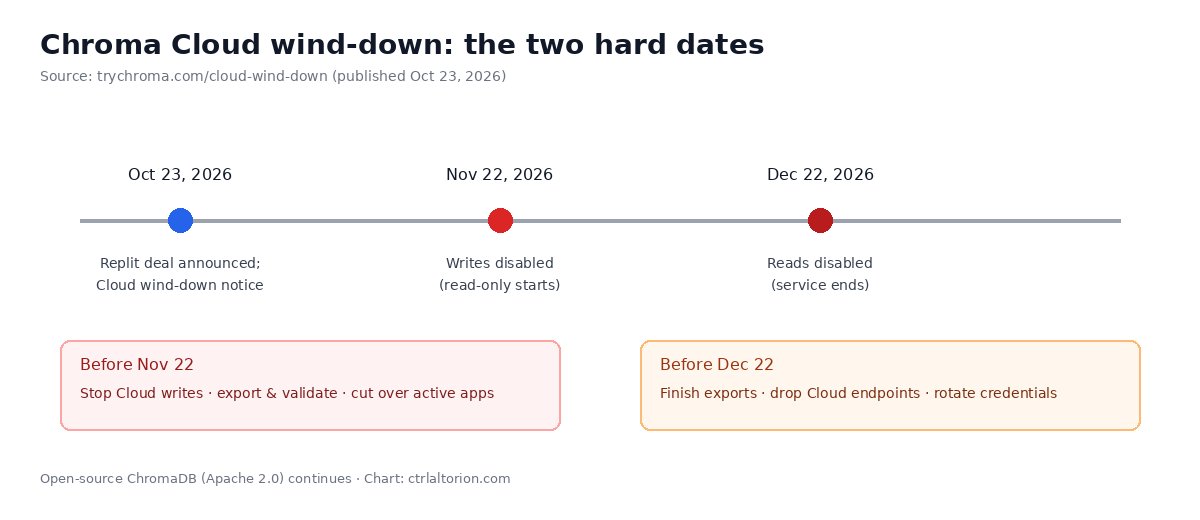 Official milestones from trychroma.com/cloud-wind-down. Chart: Ctrl Alt Orion.
November 22, 2026 — writes disabled
Thirty days after the October 23 notice, Chroma Cloud becomes read-only. Apps can no longer create, update, or delete data on Cloud. Chroma’s checklist before this date:
- Stop or redirect workloads that write to Chroma Cloud.
- Move active write paths to another Chroma deployment or database.
- Begin exporting and validating data you need to keep.
Existing data stays readable for another 30 days after writes stop.
December 22, 2026 — reads disabled
Sixty days after the notice, Chroma Cloud stops serving reads. Before that date:
- Finish every export you care about.
- Confirm migrated apps no longer hit Cloud endpoints.
- Remove or rotate Chroma Cloud credentials in apps and infra.
Support contact on the wind-down page: support@trychroma.com.
Do not wait for Dec 22 to start. After Nov 22 you can still read and export, but you cannot refresh embeddings, upsert new docs, or patch bad rows on Cloud. Production ingest that still targets Cloud will fail then.
Chroma Cloud pricing (what you were paying)
Chroma Cloud pricing was usage-based while the product was alive. From Chroma’s pricing page and docs pricing as published:
| Meter | Rate (vendor list) |
|---|---|
| Write | $2.50 / GiB written (logical, uncompressed) |
| Storage | $0.33 / GiB / month (prorated hourly) |
| Query | $0.0075 / TiB queried |
| Network out | $0.09 / GiB returned |
| Collection fork | $0.03 / fork (Cloud-only feature) |
Plan shells: Starter $0/month + usage ($5 credits for new users), Team $250/month + usage ($100 included credits that do not roll over, per FAQ), Enterprise custom / BYOC. Sync had separate rates ($0.04/GiB processed, $0.01/page extracted or scraped).
Useful as a baseline when you compare Chroma DB alternatives: after Cloud, you trade those meters for a VPS, Postgres plan, or Vectorize dimensions. Collection forking was Cloud-only (copy-on-write); self-hosted single-node Chroma needs full copies if you relied on forks.
Open-source ChromaDB is not shutting down
This is the piece people get wrong in Slack. Chroma Cloud ≠ ChromaDB.
- Cloud = managed hosted service with the Nov 22 / Dec 22 cutoffs.
- ChromaDB = open-source project, Apache 2.0, still downloadable and self-hostable.
- Chroma says more private code was opened for continuity; Replit says it will contribute as it extends the stack for enterprise context.
What is unknown (label as open): long-term release cadence, how public ChromaDB features will relate to proprietary Replit/Foundation packaging, and when (if ever) Replit exposes Chroma-backed APIs as a general product. AlphaSignal correctly flags those as missing governance details. For migration week, treat Apache 2.0 self-host as the continuity path Chroma itself advertises.
Export first: use the official chroma copy CLI
Do not invent a one-off scraper if the published tool works. Chroma documents Copy Collections: copy between local Chroma and Chroma Cloud both ways.
Cloud → local (the direction you need):
# All collections from a named Cloud DB into a local server
chroma copy --from-cloud --all --db my-db

# Or named collections only
chroma copy --from-cloud collections col-1 col-2

# Target a specific local host or data path
chroma copy --from-cloud --all --db my-db --host http://localhost:8050
chroma copy --from-cloud --all --db my-db --path ~/Developer/my-app/chroma
Defaults: local Chroma at localhost:8000 unless you set host or path. The CLI prompts for a Cloud DB if you omit --db and have an active profile.
Validate after copy (ours): matching collection names and counts; same embedding dimension and model; metadata filter keys present; golden queries with comparable top-k IDs/scores. Watch for incomplete CLI runs. Keep Cloud credentials until Dec 22 for re-export if needed—then rotate them.
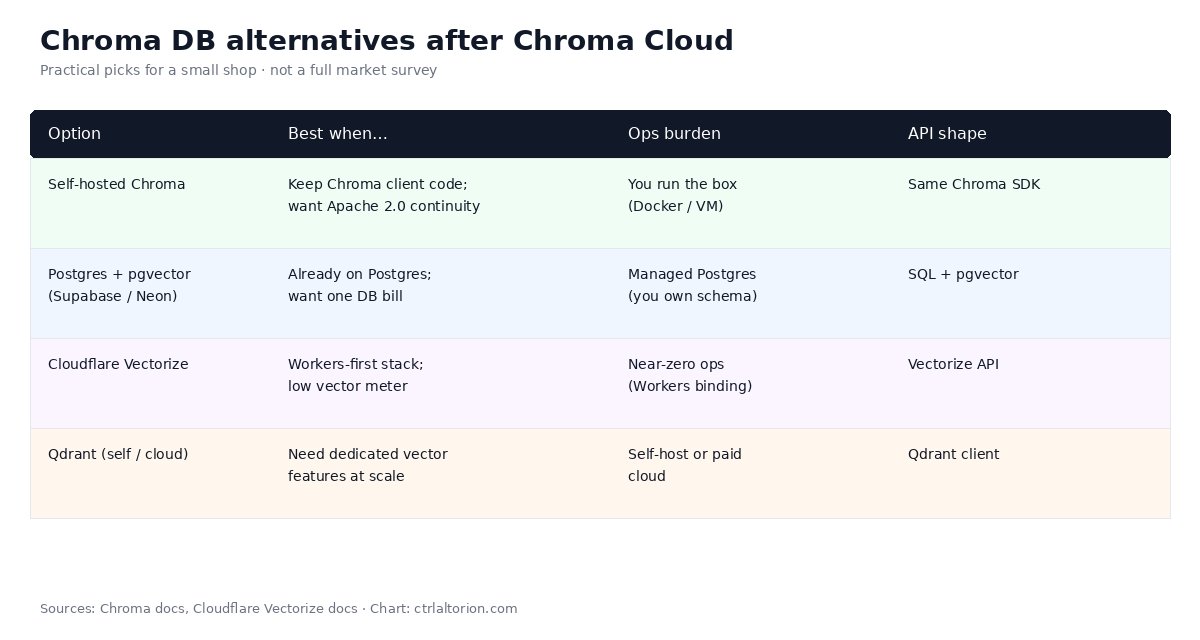 Export-first flow using Chroma’s published CLI. Chart: Ctrl Alt Orion.
Pick a destination: three practical paths
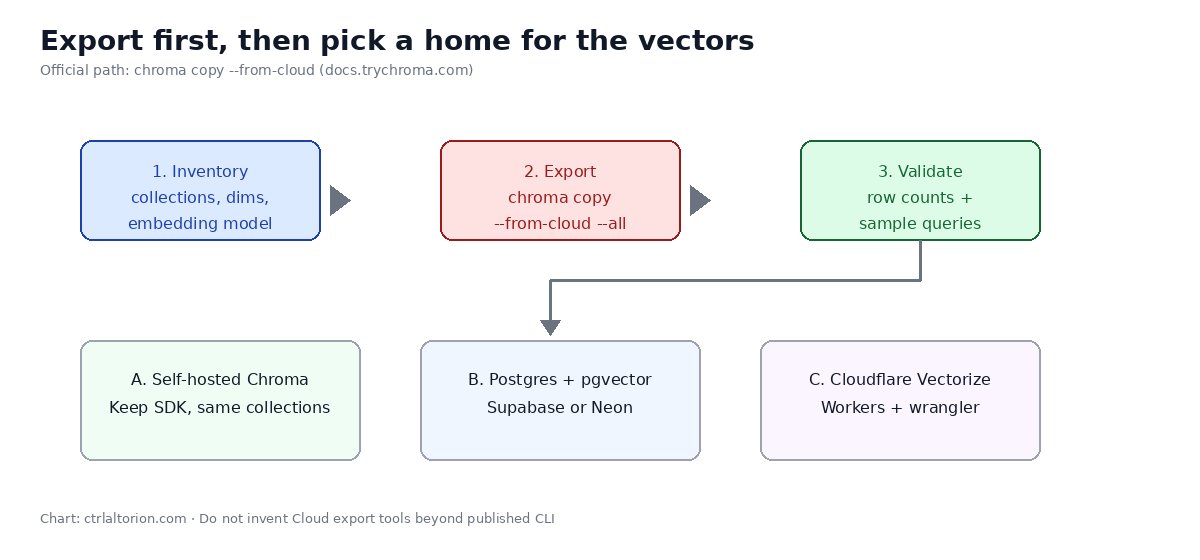 Small-shop oriented comparison, not a full vendor matrix. Chart: Ctrl Alt Orion.
Path A — Self-hosted Chroma (least code change)
Best when: you want the same Python/JS Chroma client, the same collection mental model, and Apache 2.0 continuity without rewriting query code.
How: run Chroma via Docker or a small VM, point chroma copy --from-cloud at that host, flip your app’s client config from Cloud credentials to the local/HTTP URL, re-run golden queries.
Tradeoffs: you own uptime, backups, upgrades, and multi-tenancy. Chroma’s Cloud features such as collection forking and serverless scaling do not automatically appear on a single-node box. For many hobby and early SaaS RAG apps this is still the fastest cutover.
Path B — Postgres + pgvector (Supabase or Neon)
Best when: you already run Postgres (or want one bill for rows + vectors), your team thinks in SQL, and you are fine rewriting the retrieval layer.
pgvector vs chromadb in one paragraph: Chroma is a purpose-built retrieval store with collections, embeddings, and metadata filters as first-class client APIs. pgvector is a Postgres extension—vectors live next to your users table, you write ORDER BY embedding <=> $1, and you manage indexes (ivfflat / hnsw) yourself. You gain transactions and familiar backups; you lose Chroma’s collection UX unless you rebuild it.
Managed options small shops already use:
- Supabase — Postgres + pgvector in the usual Supabase project; good if Auth/Storage already live there.
- Neon — serverless Postgres with pgvector; strong branch/fork story for schema work.
We compared the two for bootstrapped SaaS ops and pricing tradeoffs in Supabase vs Neon for bootstrapped SaaS—both support pgvector; AI features alone rarely decide the pick.
Migration sketch (conceptual): export embeddings + ids + documents + metadata from Chroma (via local Chroma after copy, or SDK pagination), create a table with vector(N) matching your dimension, bulk insert, build an ANN index, replace collection.query with SQL. Re-embed only if you change models—do not mix dimensions.
Path C — Cloudflare Vectorize (Workers-native)
Best when: your app already runs on Cloudflare Workers (or you are moving that way) and you want a managed vector index without running Postgres or Chroma.
Per Cloudflare’s Vectorize docs: GA vector database for Workers; create indexes with Wrangler (wrangler vectorize create … --dimensions=… --metric=…), bind them in wrangler.toml / wrangler.jsonc, insert/query from Workers. Dimensions and distance metric are fixed at create time. Metadata filters need metadata indexes created up front (up to 10). Max dimensions 1536 (float32); max 20M vectors per index on current limits pages—check limits before you assume a giant corpus fits.
Vectorize pricing (vendor): bills on queried and stored vector dimensions. Workers Free includes 30M queried / 5M stored per month; Paid includes first 50M queried + 10M stored, then about $0.01 / million queried and $0.05 / 100 million stored. No charge for idle “index hours.” Re-check Vectorize pricing before you budget.
Workers-shaped AI work on this site: Cloudflare Clairic invoice extraction. Related tooling posts (live): stateless MCP solo builder guide, cf CLI migrating from Wrangler.
Import note: no official Chroma Cloud → Vectorize one-click. Export, map Chroma ids to Vectorize ids, upsert in batches (Workers batch limit 1000 per limits docs), dual-run queries until scores look sane.
pgvector vs chromadb vs qdrant (short table)
Targets people type into Google when Cloud dies. Keep the comparison honest and short:
| ChromaDB (self-host) | Postgres + pgvector | Qdrant | |
|---|---|---|---|
| Mental model | Collections + embeddings API | SQL table + extension | Dedicated vector DB |
| Ops | You host Chroma | You host/manage Postgres (or Supabase/Neon) | Self-host or Qdrant Cloud |
| Best fit | Keep existing Chroma clients | Unified app DB | Heavier vector feature needs |
| Cloud-specific loss | Forking / serverless Cloud meters go away | N/A | N/A |
Qdrant is a common Chroma DB alternative when you want a dedicated vector engine (self-host or Qdrant Cloud) and will learn a new client. Pinecone, Weaviate, LanceDB and others compete too—this article does not rank them. Pick one destination, finish the export, then optimize.
Calendar for a small team
- This week: Inventory every Cloud client (env, secrets, notebooks, cron). Practice
chroma copyon a non-prod DB into local Chroma, pgvector, or Vectorize. - By Nov 15: Dry-run export + golden queries green; write path ready to flip.
- By Nov 22: All writes off Cloud (read-only safety net only).
- By Dec 15: Final export; apps only on the new store.
- By Dec 22: Reads die—rotate keys, purge Cloud secrets.
Same two-gate discipline as other API shutdowns; see our GPT-4o API shutdown migration for the calendar mindset (different vendor, same urgency).
Replit / Foundation (not your migration target yet)
Chroma says Foundation hit SOTA on BEAM and continues inside Replit—that is a vendor claim, not a product you can buy this month. Until Replit publishes hosted retrieval APIs, regions, pricing, and SLAs, leave Cloud via self-serve export + open-source Chroma or another store above.
Our take
Chroma Cloud customers should treat November 22, 2026 as the real cliff for application health (writes), and December 22, 2026 as the data-loss cliff (reads). Open-source ChromaDB continuing under Apache 2.0 is the continuity Chroma promised—use chroma copy --from-cloud this week, validate counts and recall, then either keep Chroma self-hosted or move vectors into Postgres+pgvector or Cloudflare Vectorize. Do not wait for a Replit-hosted replacement to ship inside the 60-day window. Label every benchmark and download-share claim as Chroma’s; re-read the wind-down page before you delete credentials.
FAQ
When does Chroma Cloud shut down?
Per Chroma’s wind-down page: writes disabled November 22, 2026; reads disabled December 22, 2026. Notice published October 23, 2026.
Did Replit buy Chroma?
Chroma announced a definitive agreement to join Replit on October 23, 2026. Financial terms were not disclosed in Chroma’s post.
Is ChromaDB still open source?
Yes. Chroma says open-source ChromaDB remains under Apache 2.0, with additional private code contributed and Replit continuing to contribute. The wind-down applies to Chroma Cloud, not the open-source project.
What was Chroma Cloud pricing?
Usage-based list rates included $2.50/GiB written, $0.33/GiB-month storage, $0.0075/TiB queried, $0.09/GiB returned, plus Starter/Team/Enterprise plan shells. See Chroma’s pricing docs for the full meter definitions.
How do I export from Chroma Cloud?
Use the official CLI: chroma copy --from-cloud --all --db <name> (or named collections) into a local Chroma host or path, as documented on docs.trychroma.com. Then validate counts and queries before cutting over.
What are the best Chroma DB alternatives right now?
For a small shop leaving Cloud: self-hosted Chroma (least rewrite), Postgres + pgvector on Supabase or Neon (one database), or Cloudflare Vectorize (Workers-native). Qdrant is a strong dedicated-vector option if you want that ecosystem. Choose based on existing stack, not blog rankings.
pgvector vs chromadb — which should I pick?
Keep ChromaDB if you want the same client APIs and collection model. Choose pgvector if vectors should live beside app data in Postgres and you accept SQL-shaped retrieval. They solve overlapping problems with different ops and APIs.
pgvector vs chromadb vs qdrant?
Chroma = embedding-collection DX; pgvector = Postgres extension; Qdrant = dedicated vector database (self-host or cloud). After Chroma Cloud ends, any of the three can host your vectors—migration cost is mostly export + client rewrite + recall testing.
Does Cloudflare Vectorize replace Chroma Cloud?
It can for Workers apps that need a managed vector index, within Vectorize’s dimension and scale limits. It is not an API-compatible drop-in for the Chroma client; you re-upsert vectors and change query code.
Will Foundation or Replit host my vectors?
Not as a documented customer product in the October 23 materials. Plan the migration yourself using the wind-down timeline and open-source Chroma.
Sources
11 refs- Chroma, “Chroma is joining Replit” (October 23, 2026): https://www.trychroma.com/blog/chroma-joins-replittrychroma.com
- Chroma, “Chroma Cloud wind-down timeline” (published October 23, 2026): https://www.trychroma.com/cloud-wind-downtrychroma.com
- Chroma Docs, “Copy Collections” (
chroma copy): https://docs.trychroma.com/docs/cli/copydocs.trychroma.com - Chroma, Pricing: https://www.trychroma.com/pricing/trychroma.com
- Chroma Docs, Cloud pricing: https://docs.trychroma.com/cloud/pricingdocs.trychroma.com
- Cloudflare Docs, Vectorize overview: https://developers.cloudflare.com/vectorize/developers.cloudflare.com
- Cloudflare Docs, Vectorize pricing: https://developers.cloudflare.com/vectorize/platform/pricing/developers.cloudflare.com
- Cloudflare Docs, Vectorize limits: https://developers.cloudflare.com/vectorize/platform/limits/developers.cloudflare.com
- AlphaSignal, “Replit Acquires ChromaDB and Shuts Down Chroma Cloud in 60 Days” (October 23, 2026): https://alphasignal.ai/news/replit-acquires-chromadb-and-shuts-down-chroma-cloud-in-60-daysalphasignal.ai
- Runtime Wire, “Chroma joins Replit to build a context layer for company agents” (October 23, 2026): https://runtimewire.com/article/chroma-joins-replit-agent-contextruntimewire.com
- ExplainX, Chroma joins Replit / Cloud 60-day wind-down coverage (October 23, 2026): https://www.explainx.ai/blog/chroma-joins-replit-chroma-cloud-60-day-wind-down-chromadb-apache-2-what-to-do-2026explainx.ai
comments
loading comments…
No comments yet. Start the thread.