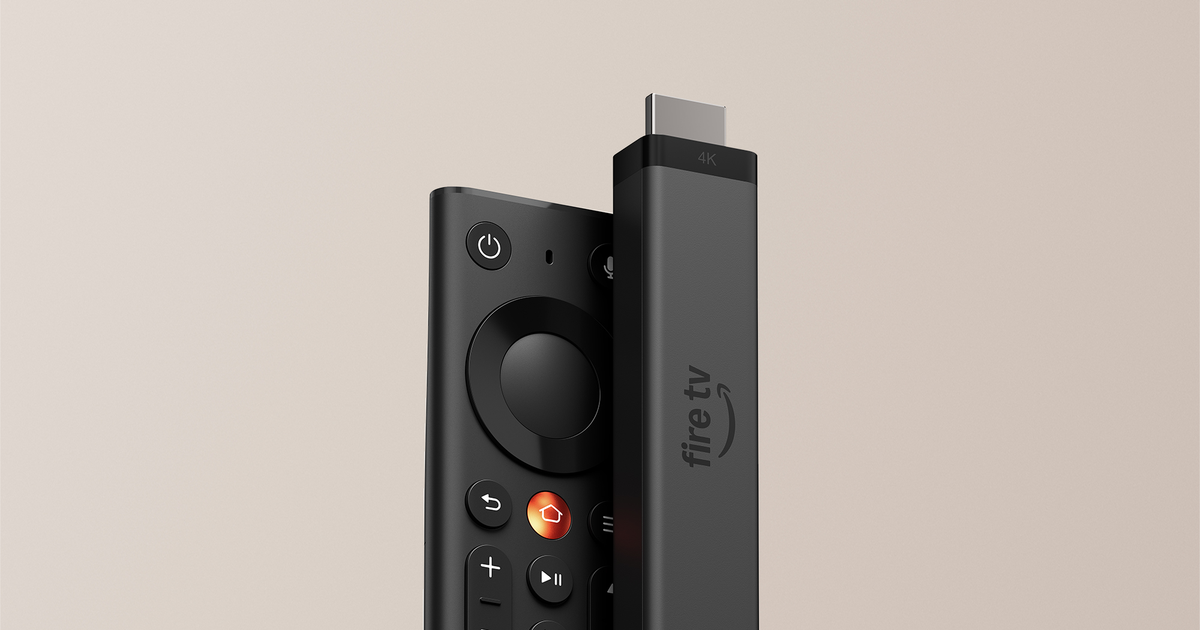
Header image: The new Fire TV Stick 4K (2026) with the redesigned Fire TV Remote, from Amazon’s device announcement. Image: Amazon.
Disclosure: some links below are Amazon affiliate links (tag cao04-20). Costs you nothing; the picks don’t change.
Note: Amazon announced this stick on September 30, 2026. The $29.99 Prime Big Deal Days price ran October 6-7 and is over. This is current as of October 11.
The new Fire TV Stick 4K is a $59.99 streamer whose $29.99 debut weekend came and went. If you bought it during Prime Big Deal Days, you already have it. If you didn’t, the question changed: not “is this worth $30” — at that price almost anything with an HDMI port is worth $30 — but “is this worth $59.99, today, for a shop television nobody watches closely enough to justify an AV project.” It is a consumer HDMI stick, not a signage player, not a register, and not the model that does Dolby Vision. If the television in the break room takes twenty seconds to open an app, this is still the cheap fix. If the TV is only annoying in theory, the correct move this week is to wait for the next sale, not to buy at list.
Amazon’s own device post is the price source. The stick is $59.99, and Amazon started shipping it in the United States and a list of other countries, with more countries following in late October. It ships with the new Fire TV Remote. The separate remote, sold on its own for $14.99, is the thing that does not ship until late October. Do not confuse those two sentences — the stick itself is shipping now.
Fire TV Stick 4K (2026) — check the current price
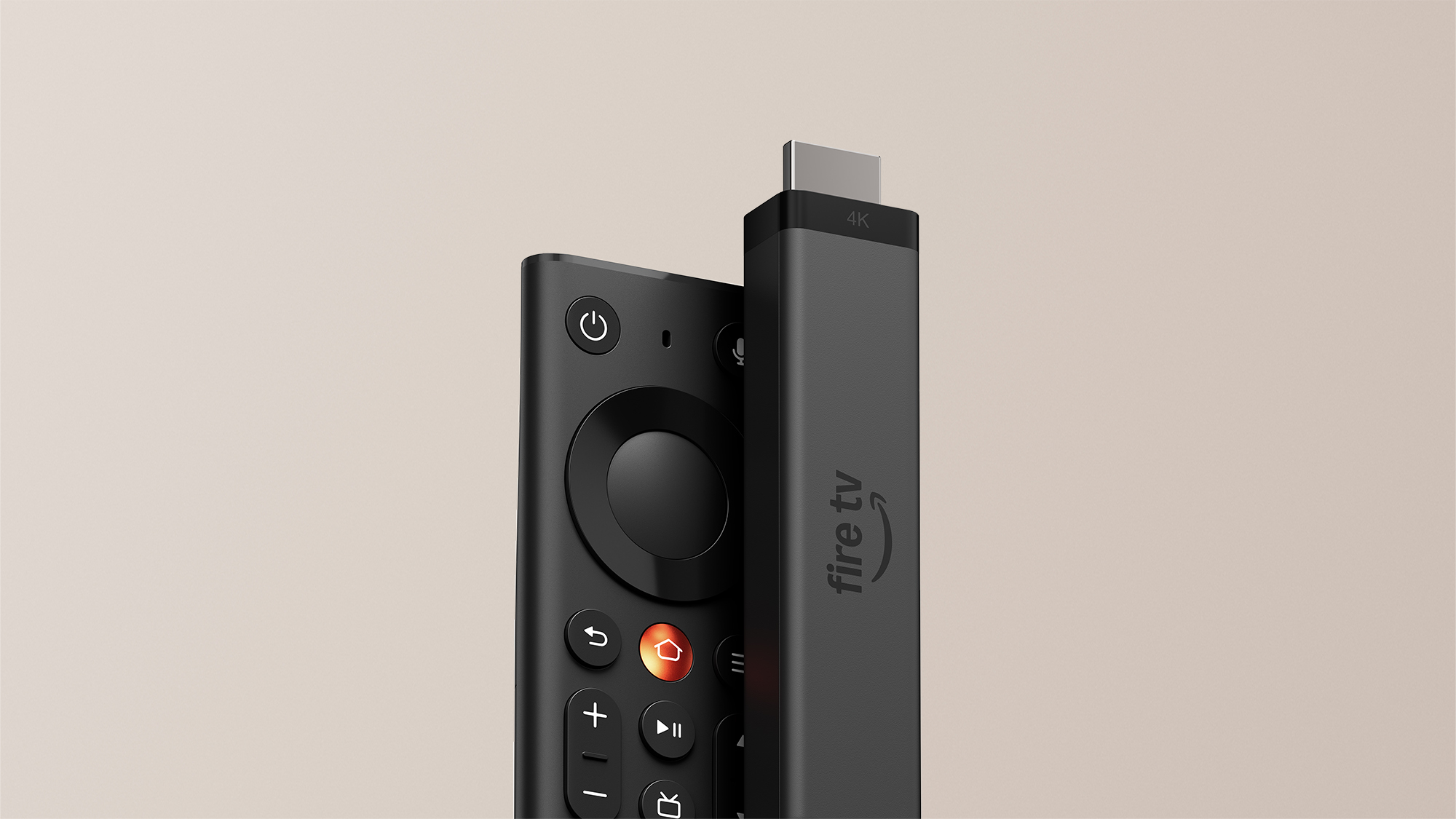
The new Fire TV Stick 4K (2026) — 8 GB, Wi-Fi 6, Vega OS — with the redesigned remote it ships with. Image: Amazon.
What you actually get for $59.99
Amazon’s spec list, from the same device announcement, is short enough to trust because it is short.
The stick has 8 GB of internal storage and a quad-core 1.7 GHz processor. It does Wi-Fi 6, Bluetooth 5.3, and Bluetooth Low Energy. Video formats are HDR10, HDR10+, HLG, H.265, H.264, VP9, and AV1, at 2160p, 1080p, or 720p, up to 60 frames per second. It runs Vega OS and comes with Alexa+ and the newer Fire TV interface. Like the Fire TV Stick HD from earlier this year, the body is the slimmer one, and Direct Power means the included cable can draw power from the TV’s USB port so you can skip the wall brick.
What it does not have is Dolby Vision. Amazon’s lineup note puts Dolby Vision, Dolby Atmos, and the “Alexa+ Home Theater” features on the Fire TV Stick 4K Max, which Thurrott reported at $84.99. The photo below is that Max, the 16 GB Wi-Fi 6E model. It is not the $59.99 stick.
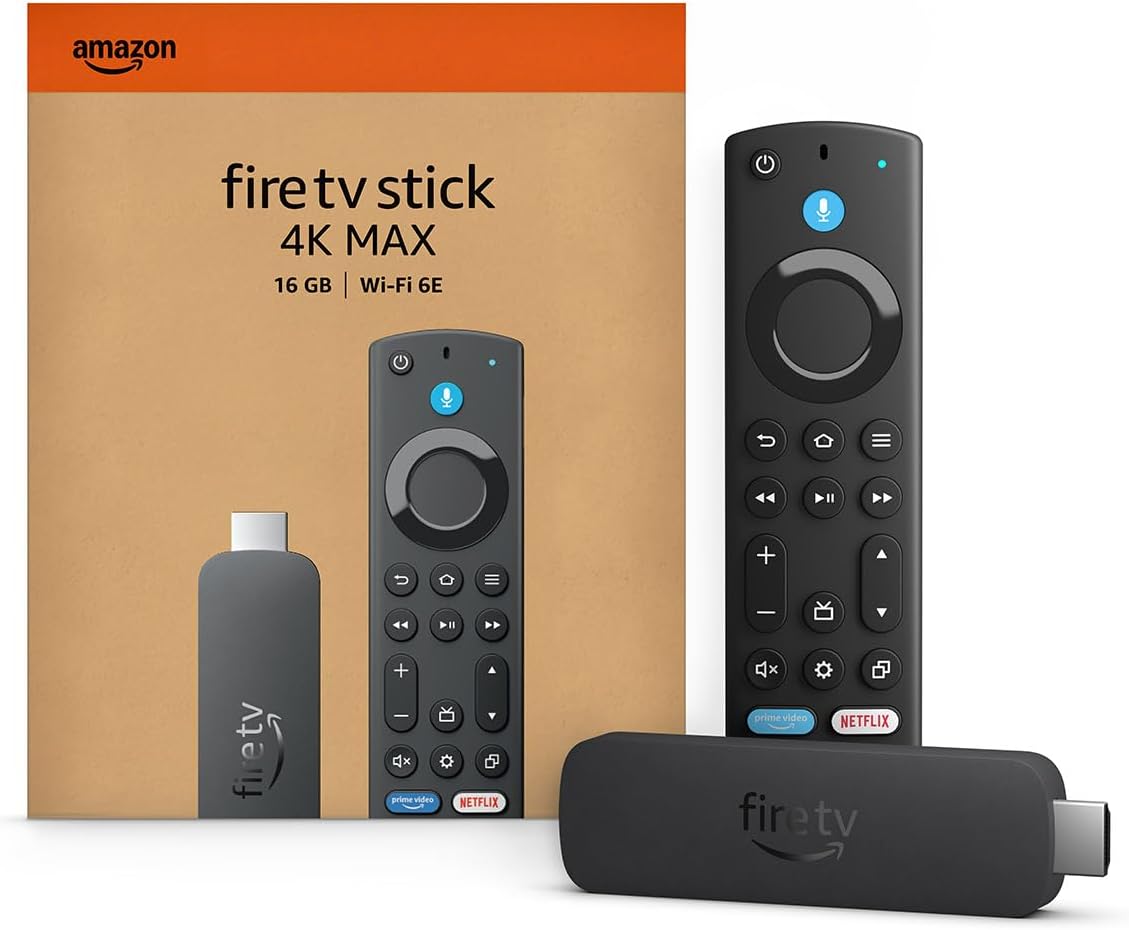
The Fire TV Stick 4K Max — the one with Dolby Vision and Atmos, and the one a break room does not need. Image: Amazon.
If the reason you are shopping is a TV that makes a big deal out of Dolby Vision discs and apps, you are in the wrong row of the chart. HDR10 and HDR10+ are not the same sentence as Dolby Vision, and a shop does not need a lecture on the difference. You need to know which one your TV and your apps actually use before you congratulate yourself on a sixty-dollar stick that cannot pass that signal.
Amazon also says that since the first Vega OS Fire TV device last year it has added over 2,000 apps, naming Spotify, Xbox, VLC, and “a range of VPNs,” on top of Netflix, Disney+, YouTube, Prime Video, and the other apps a break room already has. App count is not a reason to buy. The apps you already pay for either open or they do not. A VPN on a break-room stick is a hobby, not an ops requirement.
The speed lines are Amazon’s own tests. The company says the stick gets people to content “nearly 20–40 percent faster” than a similarly priced 4K stick from another brand it does not name: faster power-on, apps launching over 35 percent faster, content starting nearly 20 percent faster. It also says the stick beat the built-in apps on three 4K TVs from “top-selling brands,” averaged across the three most popular Fire TV apps. Useful as a claim about slow built-in TV software. Useless as a number you can reproduce, because the other stick and the three TVs are unnamed. If your TV is the slow one, you already know. You do not need Amazon’s percentage to justify a $60 experiment. You need it not to be the only reason you buy the $85 Max.
The lineup Amazon just shortened
Amazon says the stick family is now three tiers, plus the Cube for people who want hands-free Alexa.
| Model | The job Amazon assigns it | The catch a shop should care about |
|---|---|---|
| Fire TV Stick HD | Everyday streaming, the cheap one | Not 4K. Fine for a back-office TV nobody watches closely. |
| Fire TV Stick 4K | ”Best balance of speed and value,” 4K, HDR10 / HDR10+ | No Dolby Vision. This is the new $59.99 one. |
| Fire TV Stick 4K Max | Gamers and home theater; Dolby Vision and Atmos | Thurrott’s reported price is $84.99. Overkill for a break room. |
| Fire TV Cube | Hands-free Alexa, the enthusiast box | A counter does not need a Cube. |
Thurrott, citing the launch, says this 4K stick replaces the old 4K Select and 4K Plus names. Amazon’s own post says other existing models continue while supplies last. If a listing still says Select or Plus, read the title twice. Those are the names being retired, not a secret cheaper version of the new stick.
The remote in the box is the new shape: flat top, heavier curved bottom, a metal home button, and a star button you can point at one app or at closed captions. Amazon says that star button used to be reserved for the more expensive remote. The remote pairs with Ember TVs and with Fire TV streamers launched from 2019 on. A Fire TV Remote Plus, aluminum and backlit, with “Alexa, find my remote,” is expected in early 2027 and replaces the Alexa Voice Remote Pro. You do not need to wait for it. The stick includes a remote now.
The standalone remote at $14.99 is the late-October ship. Buy that only if an older Fire TV device in the shop has a remote that has disappeared into the couch in the break room. Do not delay the stick itself waiting on a remote that already comes in the box.
The $59.99 math, done in dollars instead of slogans
The $29.99 price was a Prime-member event price, and the event is over. What is left is a straightforward $59.99 list price, and the decision is only interesting because the next sale is predictable.
| Situation | What $59.99 buys you | The alternative |
|---|---|---|
| A specific TV that is annoying every single day | The fix, now. Ten minutes of installation and the complaint stops. | None worth taking. Pay it. |
| A TV that is annoying in theory, not daily | A fix nobody will thank you for. | Wait for the next sale event — Amazon discounts its own sticks at every major event, and the $30-tier price has already existed once this month. |
| A TV whose built-in apps are actually fine | A remote nobody asked for. | Keep the money. Test first: open the app you actually watch and time it once. |
| You are tempted to join Prime to “unlock deals” for later | Nothing you can’t already buy. | A $139 membership to save $30 on a stick is a loss, at any sale price. |
Amazon’s event post explains the mechanics, because they will matter again at the next sale: deals during these events are for Prime members, at $14.99 a month or $139 a year, with a free 30-day trial if you are eligible. At list price none of that is on the table — $59.99 is the price for everyone. If you skipped the event on purpose, the membership is not the lesson; the timing is. Black Friday is roughly six weeks out, and a stick that debuted at $29.99 this month has a history of returning to sale pricing during the events that matter to Amazon’s own device calendar.
Believe the button, not this article, if they disagree. Prices move. The search link above shows today’s number.
Where a shop should plug it in, and where it should not

A wall-mounted TV over a work table — the honest home for a sixty-dollar streaming stick. Photo: Max Vakhtbovych / Pexels.
Break room, back office, the TV above the tire rack. This is the honest use. A television that shipped with slow built-in apps, one free HDMI port, and a USB port that can feed the stick. Direct Power is worth trying because it removes a brick from a power strip that is already full. If the TV’s USB port will not hold the stick up, use the wall adapter and move on. Do not spend an hour diagnosing a USB port to save one outlet.
Lobby menu or a price board. Do not. A Fire TV stick is a streaming client signed into someone’s Amazon account. A menu board should not depend on that account, on Alexa suggestions, or on whichever app a closer left open. If the thing on the wall is a smart TV, the problem may be the television itself being on the shop network. That is the subject of the LG signage piece. A $60 stick does not make a lobby television a managed display.
The customer counter. Also no. A counter display that takes orders is a tablet problem, and the answer is still whichever device your menu or POS page actually supports. The budget tablet guide is the piece for that. An HDMI stick behind a television is a different shape of hardware for a different job.
A TV that is already fast. Leave it alone. Replacing working built-in apps to collect a gadget is how a break room gains a remote nobody asked for. The test is dull: open the app you actually watch, time it once, and only then decide the built-in software is the problem.
The remote will get lost, so decide that now
A break room with four people will lose a remote. The new shape is supposed to be easier to pick up in the right direction without looking. That is a nice design note and it will not stop the remote from living in a drawer. The Find My Remote feature Amazon is proud of arrives on the Remote Plus in early 2027, not on the remote in this box. Until then the recovery plan is the same as every other shop TV: a piece of bright tape, or a second cheap remote once the $14.99 one actually ships.
Do not sign the stick into the owner’s personal Prime video profile if the break room is in the habit of buying movies. One accidental purchase is worth more than the stick. Use a separate Amazon login that does not have a card on it, or accept that the stick only opens the free apps you already use. Write that down before someone “sets it up real quick” on a Saturday.
A break room with four people and one slow TV
Picture the room. A 43-inch television from 2021, built-in apps that take long enough that people give up and talk instead, one HDMI port already used by nothing, and a power strip under the counter with one socket left. That is the purchase. Pull the stick out, plug in HDMI, try the TV’s USB port for Direct Power, and sign in with an account that cannot buy movies. The whole job is ten minutes if the USB port cooperates and half an hour if it does not.
What the ten minutes does not include is a policy. Write one line on the whiteboard: this TV plays the free apps, nobody one-clicks a rental, and the remote lives on the hook. A four-person shop will not hold a meeting about a streaming stick. They will hold a grudge about a $19 movie someone bought on the owner’s account. The separate login is the whole control system. There is no admin console worth learning on a Fire stick, and pretending there is will waste the afternoon.
At $59.99 the bar is honest: the TV has to be annoying every day, not annoying in theory. That is the difference between a purchase and a habit. If the answer today is “it’s more of a someday thing,” someday is late November — the sale events where this stick goes back to $30-tier pricing come around on a calendar you can set your watch to, and waiting costs nothing but the complaining you were already tolerating.
Shipping is the other place the listing can surprise you. Amazon’s announcement says the stick ships in the US, Canada, Japan, Mexico, the UK, Germany, France, Italy, Spain, Switzerland, and Australia, with other countries later in October. If your delivery estimate says late October, you are either outside that first list or you are looking at a later batch. The stick and the standalone remote are different SKUs. A late date on the $14.99 remote is normal. A late date on the stick is a reason to read the delivery line before you tell the break room it arrives tomorrow.
HDMI-CEC is the last ordinary failure. The new remote is designed to control the TV’s power and volume. On some sets that means two devices fight over the input and the TV wakes on a timer nobody set. If the television starts turning itself on after you install the stick, turn CEC off on the TV or stop using the stick’s power button and use the TV’s own remote for power. That is a five-minute setting, not a defective stick, and it is the kind of thing that makes a shop pull the HDMI cable and call the purchase a waste.
When not to buy this
Do not buy the Fire TV Stick 4K if you need Dolby Vision. That is the Max, at a higher price, and a break room almost never needs it.
Do not buy it to run a menu, a queue display, or anything a customer is supposed to read. It is a streamer.
Do not buy it if the television’s built-in apps are already fast enough that nobody complains. A discount — or a new model — is not a problem statement.
Do not start a $139 Prime year to save $30 on a stick. The membership does not become a good deal because the stick went on sale.
Do not buy the standalone remote expecting it this week. Amazon says that one ships in late October. The stick’s included remote is the one that comes now.
Storage is the spec people skip. Eight gigabytes is not a library. After the operating system and two or three big apps, a break-room stick gets full, and the symptom is an app that will not update the night someone wants it. Delete what you do not watch. Do not buy the Max solely because 8 GB sounds small unless you have already filled a stick before. A break room that opens Netflix and YouTube will not fill 8 GB in a month.
Do buy it when a specific TV in the shop is slow every single day and $59.99 fits the budget line without a meeting. And if you can wait six weeks for the next sale event, do that instead — the same stick at the $30-tier price was on the table two weeks ago and the calendar says it will be again.
Sources
3 refs- Amazon, “Fire TV launches all-new, faster 4K stick and new remote” — $59.99 list price, shipping countries, specs, Dolby Vision placed on the Max, remote in the box versus the late-October standalone remote: https://www.aboutamazon.com/news/devices/fire-tv-stick-4k-new-remoteaboutamazon.com
- Amazon, “Prime Big Deal Days is back October 6-7” — event dates, the $29.99 Prime-member sale price, deal-drop times, membership at $14.99 a month or $139 a year: https://www.aboutamazon.com/news/retail/amazon-prime-big-deals-day-2026-when-october-6-7aboutamazon.com
- Thurrott, “Amazon Launches New Fire TV Stick 4K With Redesigned Remote” (September 30, 2026) — Select and Plus names retired, 4K Max at $84.99, no Dolby Vision on the new 4K stick: https://www.thurrott.com/hardware/342226/amazon-launches-new-fire-tv-stick-4k-with-redesigned-remotethurrott.com
comments
loading comments…
No comments yet. Start the thread.