
Building a production-ready mobile app in the U.S. market typically costs tens of thousands to several hundred thousand dollars, with most small-to-midsize business projects falling within a moderate hundreds of thousands dollar range. That spread is not vague hedging — it reflects three real variables: how complex your feature set is, which team model you hire, and whether you build natively or cross-platform. According to Business of Apps, simple apps run $5,000–$50,000, medium-complexity apps $50,000–$120,000, and complex builds $120,000–$300,000. Plan your maintenance budget at a moderate percentage of your initial development cost per year from day one — that recurring line item surprises more founders than the build cost itself.
Three things to do right now before you talk to a single vendor:
- Write a screen-by-screen feature list (even rough). Vendors price hours, not ideas.
- Decide your team model: U.S. agency, offshore team, or freelancers. That choice alone can significantly affect your quote.
- Identify your three non-negotiable integrations (payments, auth, maps, etc.) — each adds a few thousand dollars to scope.
Annual maintenance runs 15–25% of your original build cost. A $100,000 app costs $15,000–$25,000 per year just to keep it current, secure, and running.
Key Takeaways
Mobile app development costs range from $5,000 for a minimal MVP to $300,000+ for a complex production platform, with most SMB projects landing between $50,000 and $150,000 depending on team model, platform, and feature scope.
| Point | Details |
|---|---|
| Budget by complexity tier | Simple apps run $5,000–$50,000; medium $50,000–$120,000; complex $120,000–$300,000. |
| Phase allocations matter | Development consumes 40–55% of budget; discovery and design together account for 25–40%. |
| Team model moves the number | The same 1,000-hour project costs $25,000–$60,000 offshore vs. $100,000–$180,000 with a U.S. agency. |
| Plan for annual maintenance | Budget 15–25% of your build cost every year for updates, security, and OS compatibility. |
| Ctrlaltorion for SMB builds | Ctrlaltorion delivers end-to-end mobile app builds for small businesses, from $25,000 MVPs to $150,000 platforms, with structured phase estimates. |
Table of Contents
- How Much Does Mobile App Development Cost by Complexity?
- What Does a Phase-by-Phase Budget Breakdown Look Like?
- How Does Your Team Choice Change What You Pay?
- Which Platform and Technology Choices Drive Your Budget Up or Down?
- What Hidden Costs Will Catch You After Launch?
- How Do You Estimate Your Project and Get Accurate Quotes?
- Benchmarks and Data Behind These Ranges
- What Small Businesses Usually Get Wrong About App Budgets
- Ctrlaltorion Builds Production Mobile Apps for Small Businesses
- Sources
How Much Does Mobile App Development Cost by Complexity?
Complexity is the single biggest cost driver, and it maps almost directly to your feature checklist. Let’s be precise about what “simple,” “medium,” and “complex” actually mean in practice — because every vendor uses those words differently.
Simple apps ($5,000–$50,000)
A simple app has one or two core user flows, no real-time data, and minimal backend logic. Think: a restaurant menu browser, a basic appointment scheduler, or a loyalty card tracker. Typical features include:
- Email/social authentication (no custom auth server)
- Read-only or lightly writable database (Firebase or Supabase)
- Push notifications via a third-party service
- One or two static screens with basic navigation
- No payment processing, no admin panel, no analytics dashboard
Timeline: 4–12 weeks. These are often MVP builds or internal tools. ProjectCostEstimator’s 2026 calibration puts the low end of this tier at $8,000 for a minimal build with a Backend-as-a-Service foundation.
Medium-complexity apps ($50,000–$120,000)
This is where most SMB products live. A medium app has user accounts with roles, a custom backend or a configured BaaS, payment processing, and at least one third-party integration. Examples: a booking platform, a two-sided marketplace MVP, or a field-service management tool. Feature checklist:
- Custom authentication with role-based access
- Stripe or similar payment integration
- Admin panel for content or user management
- In-app messaging or basic real-time updates
- Analytics events (Mixpanel, Amplitude, or Firebase Analytics)
- 8–20 screens across two or more user roles
Timeline: 3–6 months.
Complex apps ($120,000–$300,000+)
Complex apps involve real-time infrastructure (WebSockets, live video, IoT data streams), heavy third-party integrations, regulatory compliance (HIPAA, PCI-DSS), or machine learning features. Think: a telehealth platform, a fintech app with KYC flows, or a logistics tracker with live GPS. Clutch reports an average project cost near $90,780 across its directory — which means a meaningful share of projects exceed $120,000 once full-scope requirements are scoped in.
| Complexity | Sample features | Cost range | Typical timeline |
|---|---|---|---|
| Simple | Auth, read DB, push notifications | $5,000–$50,000 | 4–12 weeks |
| Medium | Payments, admin panel, roles, analytics | $50,000–$120,000 | 3–6 months |
| Complex | Real-time, compliance, ML, multi-integration | $120,000–$300,000 | 6–12 months |
| Enterprise | Custom infra, security audits, multi-platform | $300,000+ | 12+ months |
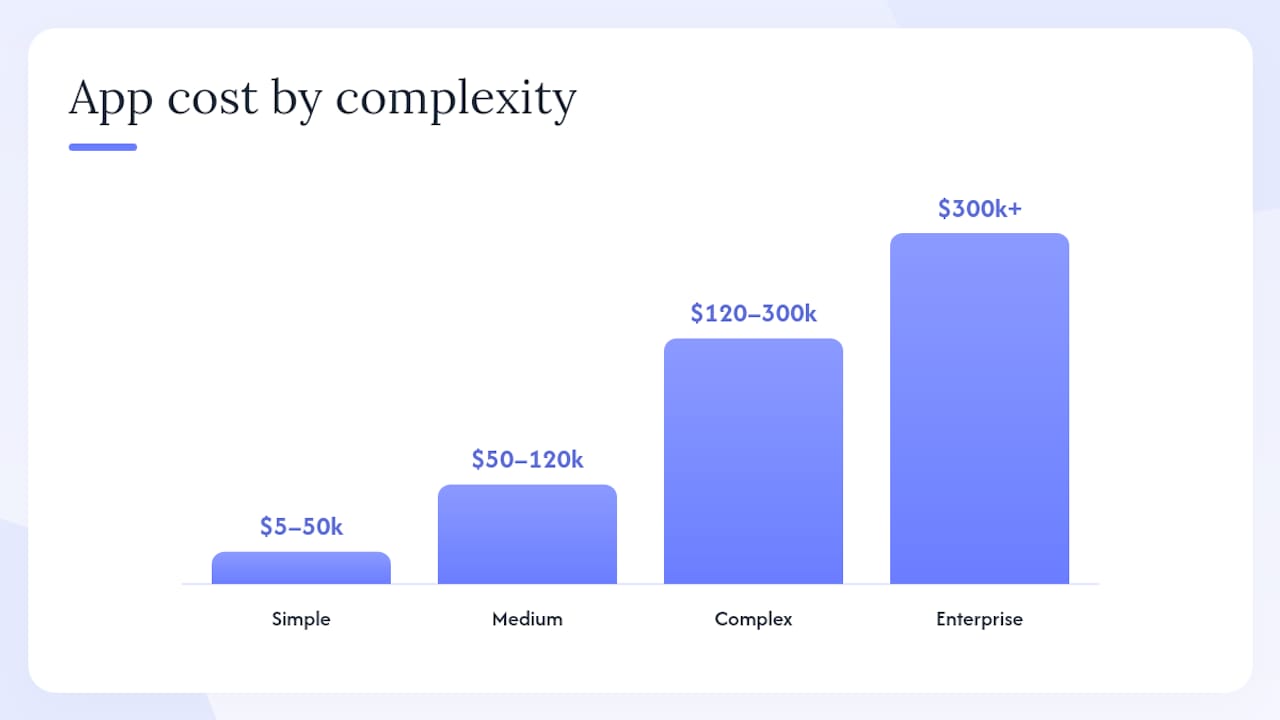
Assumptions: U.S.-based or mixed U.S./nearshore team, single cross-platform codebase (React Native or Flutter), standard cloud hosting.
What Does a Phase-by-Phase Budget Breakdown Look Like?
Most quotes arrive as a single number. That is a red flag. A well-structured project budget breaks into six phases, and knowing the percent each phase should consume tells you immediately whether a vendor is under-scoping discovery or skimping on QA.
Business of Apps recommends these phase allocations as a working model:
- Discovery (10–15%): Requirements, technical architecture, user stories, and risk identification. Skipping this phase is the single fastest way to blow your budget mid-project.
- Design (15–25%): UX wireframes, UI design system, prototype, and design QA. Higher for consumer apps where experience drives retention.
- Development (40–55%): Frontend, backend, API integrations, and core feature build. The largest single line item in every project.
- QA/Testing (10–20%): Functional testing, regression, device testing, and performance. Android’s fragmentation across device types makes this allocation higher for Android-first or cross-platform builds, given the volume of Android releases worldwide that expand the test surface.
- Deployment (5–10%): App store submission, CI/CD pipeline setup, environment configuration, and launch support.
- Maintenance/Iteration (15–25% annually): Ongoing updates, security patches, OS compatibility, and feature iteration post-launch.
| Phase | % of budget | $25,000 project | $100,000 project | $300,000 project |
|---|---|---|---|---|
| Discovery | 10–15% | $3,000–$8,000 | $10,000–$15,000 | $30,000–$80,000 |
| Design | 15–25% | $2,000–$6,000 | $15,000–$25,000 | $40,000–$70,000 |
| Development | 40–55% | $10,000–$40,000 | $40,000–$70,000 | $120,000–$300,000+ |
| QA/Testing | 10–20% | $3,000–$8,000 | $10,000–$20,000 | $30,000–$60,000 |
| Deployment | 5–10% | $1,000–$3,000 | $5,000–$10,000 | $15,000–$30,000 |
| Annual maintenance | 15–25%/yr | $2,000–$6,000/yr | $15,000–$25,000/yr | $40,000–$70,000/yr |
One practical note: discovery and design are often the most negotiated-down phases in SMB projects, and they are the two phases where cutting scope creates the most expensive rework downstream.
How Does Your Team Choice Change What You Pay?
That is not vendor dishonesty — it reflects genuine differences in overhead, coordination cost, and risk allocation.
In-house team
Hiring even a minimal in-house mobile team (one senior developer, one designer, one QA engineer) runs $300,000–$450,000 per year in fully loaded salary costs in most U.S. markets, before benefits, equipment, and recruiting fees. That model makes sense at scale, not for a first build. Upwork’s cost modeling shows how to compute project cost from developer hours multiplied by hourly rates — a useful sanity check when evaluating whether in-house hiring pencils out for your timeline.
U.S. agency
A U.S.-based agency typically charges $100–$200/hour for development, with project minimums often starting at $50,000. You get a managed team, defined deliverables, and accountability — but you pay a premium for that structure. For a 1,000-hour medium-complexity project, expect $100,000–$180,000 all-in.
Freelancers
U.S.-based freelancers on platforms like Upwork charge $75–$150/hour for mobile development. Clutch’s directory data shows many vendors cluster in the $25–$49/hour band, which typically reflects offshore or nearshore teams operating through a U.S.-facing profile. Freelancers lower your hourly rate but increase your coordination overhead — you become the project manager.
Offshore/nearshore teams
Eastern European and Latin American teams typically run $30–$75/hour. A 1,000-hour project that costs $150,000 with a U.S. agency might cost $40,000–$70,000 offshore. The trade-off is time-zone friction, communication overhead, and variable QA standards.

| Team model | Typical hourly rate | 1,000-hr project cost | Best for |
|---|---|---|---|
| U.S. agency | $100–$200/hr | $100,000–$180,000 | Accountability, managed delivery |
| U.S. freelancers | $75–$150/hr | $75,000–$150,000 | Specific skill gaps, short sprints |
| Nearshore (LATAM) | $40–$80/hr | $40,000–$80,000 | Time-zone overlap, cost savings |
| Offshore (Eastern Europe, Asia) | $25–$60/hr | $25,000–$60,000 | Maximum cost reduction |
| In-house team | $300k–$450k/yr salary | N/A (annual cost) | Long-term product ownership |
Pro Tip: *When using offshore or freelance teams, structure payments around milestone deliverables tied to automated test coverage thresholds — not calendar dates.
Which Platform and Technology Choices Drive Your Budget Up or Down?
Platform and stack decisions made in week one of a project can add or subtract $30,000–$80,000 from the final invoice. Most founders treat this as a technical question. It is a financial one.
Native vs. cross-platform
For most SMB use cases, cross-platform is the right starting point. The Statista app market outlook shows near-equal global platform adoption between iOS and Android, which means skipping either platform costs you audience reach — and native-only builds on both platforms cost you budget.
Custom backend vs. Backend-as-a-Service
A custom REST or GraphQL API built from scratch adds 200–400 hours of backend development to a medium-complexity project. Firebase and Supabase can replace that work in 2–4 weeks of configuration, saving 6–10 weeks of backend development time and materially reducing initial cost. The trade-off: BaaS platforms carry monthly SaaS fees that compound as your user base grows, and vendor lock-in is a real architectural risk if you ever need to migrate.
Third-party integrations
Each integration adds scope. Budget roughly:
- Payment processing (Stripe, Braintree): $3,000–$8,000
- Maps/geolocation (Google Maps, Mapbox): $2,000–$6,000
- Push notifications (OneSignal, Firebase Cloud Messaging): $1,000–$3,000
- Analytics (Mixpanel, Amplitude): $1,500–$4,000
- In-app chat (Stream, Sendbird): $5,000–$15,000
AI and no-code for MVPs
This is where 2026 genuinely changes the calculus. DesignRevision documents that AI-assisted builds and no-code toolchains can reduce MVP costs significantly for suitable projects — particularly UX-driven apps with standard data models and no real-time or compliance requirements. For a simple informational app or a basic booking flow, tools like Bubble, Webflow, or AI-generated scaffolding can cut prototype costs by a large margin. What they cannot replace: custom backend logic, real-time infrastructure, regulatory compliance flows, and anything requiring a proprietary data model. For AI-powered features within a traditional build, expect to add $10,000–$40,000 depending on whether you are calling a third-party API (cheaper) or training/fine-tuning a model (expensive). You can review how AI product pricing is structured to calibrate what ongoing AI API costs look like at scale.
Tradeoff checklist — use this to pick your approach:
- Performance-critical or hardware-dependent? Go native.
- Budget under $75,000 and timeline under 4 months? Cross-platform + BaaS.
- Validating an idea before committing full budget? No-code or AI-scaffolded prototype first.
- Compliance requirements (HIPAA, PCI, SOC 2)? Custom backend, no BaaS shortcuts.
- Long-term product with a dedicated engineering team? Custom stack from the start.
What Hidden Costs Will Catch You After Launch?
The build invoice is not the end of your financial exposure. Post-launch operating costs are where underprepared founders get surprised, and they compound annually.
Industry guidance puts annual maintenance at 15–25% of your original development cost. On a $100,000 build, that is $15,000–$25,000 per year before you add a single new feature.
Common recurring costs to budget for:
- Cloud hosting (AWS, GCP, Azure): $50–$2,000/month depending on traffic and architecture
- Database costs: $20–$500/month for managed databases (PlanetScale, Supabase, RDS)
- Third-party SaaS fees: $200–$2,000/month for analytics, monitoring, push notifications, email, and chat services
- Payment processing fees: 2.9% + $0.30 per transaction (Stripe standard rate) — not a fixed cost, but it scales with revenue
- Apple Developer Program: $99/year
- Google Play Developer account: $25 one-time fee
- Security patches and OS updates: iOS and Android release major OS versions annually, requiring compatibility testing and often code changes
- Legal and privacy compliance: GDPR/CCPA policy updates, terms of service reviews — budget $1,000–$5,000/year depending on your user base and data handling
- Monitoring and incident response: Tools like Datadog, Sentry, or New Relic run $50–$500/month; on-call engineering time is additional
Apps with real-time features (WebSockets, live video, IoT) carry higher infrastructure costs because persistent connections are expensive at scale. A chat app serving 10,000 concurrent users can run $500–$3,000/month in infrastructure alone. Regulatory compliance apps (HIPAA, PCI) add annual audit costs of $5,000–$50,000 depending on certification level.
ProjectCostEstimator’s 2026 data provides monthly ongoing cost estimates by tier — a useful cross-check when building your operating budget alongside the build quote.
How Do You Estimate Your Project and Get Accurate Quotes?
Getting three quotes that are actually comparable is harder than it sounds. Most vendors scope differently, include different deliverables, and define “launch” differently. Here is a workflow that produces apples-to-apples estimates.
Step-by-step budgeting checklist
- Write a screen inventory. List every screen your app needs, grouped by user role. A 15-screen app with two roles is a fundamentally different scope than a 40-screen app with four roles.
- Identify must-have integrations. Payments, auth providers, maps, analytics — list them explicitly. Vendors who have to guess will pad their quotes.
- Choose your target platforms. iOS only, Android only, or both? Cross-platform or native? This decision belongs in your RFP, not in the vendor’s assumptions.
- Define your MVP scope. Which features are launch-critical? Which are phase two? A disciplined MVP scope is the most effective cost-reduction lever available to you.
- Estimate your SLA requirements. How many concurrent users do you expect at launch? What is your uptime requirement? These drive infrastructure and architecture decisions that affect cost.
- Set a maintenance budget line. Allocate 15–25% of your build cost annually before you sign a development contract. If you cannot afford the maintenance, you cannot afford the build.
RFP essentials — what to require from vendors
- Detailed work breakdown structure (WBS) with hour estimates per feature
- Technology stack recommendation with rationale
- QA strategy: manual vs. automated, coverage targets, device matrix
- Deployment pipeline description (CI/CD, environments, rollback procedure)
- Code ownership clause (you own 100% of the code on final payment)
- Post-launch support terms: what is included, what is billed separately
- Third-party license costs: which services will you pay for, and at what tier
Vendor questions that expose hidden costs
- Who owns the code repository, and how is it transferred at project end?
- What test coverage percentage is included in the quoted price?
- Are third-party API costs included in the quote or billed separately?
- What happens if requirements change mid-sprint — fixed price or change-order billing?
- Do you provide a staging environment, or is testing done in production?
- What is your post-launch guarantee period, and what does it cover?
Normalizing competing quotes
When you receive three quotes for the same scope, align them on these axes before comparing dollar totals:
- Hours: Convert every quote to an estimated hour total. A $60,000 quote at $150/hour is 400 hours; a $60,000 quote at $75/hour is 800 hours. The second vendor is doing twice the work for the same price — or the first is under-scoping.
- Deliverables: Does the quote include design files, test scripts, deployment, and documentation? Or just code?
- QA allocation: A quote with no explicit QA line item is hiding that cost somewhere — or skipping it entirely.
- Launch support: Is there a 30-day post-launch support window, or does the engagement end at App Store approval?
Upwork’s cost modeling methodology — hours multiplied by hourly rate — is the cleanest normalization tool available. Apply it to every quote you receive.
Benchmarks and Data Behind These Ranges
The ranges in this guide are not invented. Here is the data that anchors them.
Developer rate benchmarks
U.S. senior mobile developers (iOS/Android) earn $120,000–$160,000 annually in base salary, translating to an effective billing rate of $85–$120/hour when you account for benefits and overhead. Mid-level developers run $90,000–$120,000 in salary. Agency rates layer a management and overhead premium on top of those figures, producing the $100–$200/hour agency range cited earlier.
Clutch’s directory shows that many vendors cluster in the $25–$49/hour band — a range that reflects offshore and nearshore teams, not U.S.-based development. The average project cost in Clutch’s data sits near $90,780, with many projects falling in the $10,000–$49,999 band (typically offshore or MVP-scope builds).
Complexity-to-cost benchmark table
ProjectCostEstimator’s 2026 calibration puts the overall range at $8,000–$420,000, with a typical mid-scope median near $58,000 — consistent with the medium-complexity band above.
DesignRevision’s 2026 analysis documents that AI-assisted and no-code builds can materially reduce MVP costs for suitable projects, though the exact reduction depends heavily on app type and complexity. Traditional agency builds for complex apps remain in the $120,000–$300,000 range regardless of AI tooling at the development layer.
What Small Businesses Usually Get Wrong About App Budgets
Most SMB founders approach app budgeting the way they approach buying a car: they fixate on the sticker price and ignore the total cost of ownership. That framing produces bad decisions.
The real question is not “how much does it cost to build?” It is “how much does it cost to run a competitive app for three years?” A $40,000 offshore build that requires $30,000/year in maintenance and constant rework because of poor architecture costs more over 36 months than a $90,000 well-scoped build with a clean codebase and a $15,000/year maintenance budget.
The second mistake is treating the MVP as the product. An MVP is a hypothesis test. Build it lean — use BaaS, use cross-platform, use AI scaffolding where it fits. But plan your architecture for what comes after validation, not just for launch day. The most expensive engineering work is rearchitecting a system that was never designed to scale.
Where to spend up front: discovery, architecture review, and design. These phases have the highest leverage on total project cost. A $10,000 discovery engagement that surfaces a scope misalignment saves $40,000 in rework. Where to save: premium U.S. agency rates for commodity work (basic CRUD screens, standard integrations).
When to hire in-house: when you have a validated product generating revenue and a clear 12-month feature roadmap. Not before. Hiring a full-time developer at $130,000/year before product-market fit is a budget risk that most SMBs cannot absorb.
Ctrlaltorion Builds Production Mobile Apps for Small Businesses
If you have read this far, you have a clearer picture of what a real app budget looks like. Ctrlaltorion builds end-to-end mobile apps for small businesses and founders — from initial scoping and architecture through launch and post-launch iteration. The team handles the full stack: React Native and Flutter cross-platform builds, custom backends and BaaS configurations, third-party integrations, and admin dashboards. Typical projects range from $25,000 MVP builds to $150,000 full-featured platforms.
Starting a scoping conversation takes 30 minutes. You describe your feature list and target users; Ctrlaltorion returns a structured estimate with hour breakdowns by phase, a technology recommendation, and a clear statement of what is and is not included. Complex enterprise projects with compliance requirements, real-time infrastructure, or multi-platform scope may exceed these ranges and receive custom quotes. Ctrlaltorion — bring your screen list and your three must-have integrations, and the conversation will be productive from minute one.
Sources
4 refs- App Development Pricing Guide June 2026clutch.co
- How Much Does It Cost To Build a Mobile App? - Upworkupwork.com
- App Development Cost: What to Expect in 2026designrevision.com
- How Much Does an App Cost in 2026? Real Pricing by Scopeprojectcostestimator.com
comments
loading comments…
No comments yet. Start the thread.