
Building an ecommerce website in 2026 costs anywhere from $500 for a bare-bones DIY setup to $250,000+ for a fully custom enterprise build — and for most small-to-mid U.S. businesses, the first-year budget typically falls in a moderate range depending on platform choice, catalog size, and how much custom work you need. That range isn’t vague hedging; platform choice alone drives 50–70% of your total build cost, which means the single most important budgeting decision you’ll make is which foundation you build on.
The number to write down right now: Budget a minimum of $5,000 for a functional small business ecommerce site with professional design, payment processing, and basic integrations. If you’re sourcing quotes from agencies, expect $6,000–$35,000 for a mid-range build. Anything below $2,500 is a freelancer-minimum project with significant scope constraints.
Before you request a single quote, separate one-time costs (design, development, theme, setup) from recurring costs (hosting, apps, payment processing fees, maintenance). Conflating them is the fastest way to blow your first-year budget. Get itemized proposals, not lump sums.
- Small DIY/template store: $500–$5,000 one-time, plus $30–$150/month recurring
- Hosted builder store (Shopify, Wix, Squarespace, BigCommerce): $3,000–$15,000 one-time, plus $50–$300/month recurring
- WordPress + WooCommerce: $2,000–$25,000 one-time, plus $50–$200/month recurring
- Custom/agency build: $15,000–$100,000+ one-time, plus $200–$1,000+/month recurring
Key Takeaways
For most U.S. small-to-mid businesses in 2026, a functional ecommerce website costs $5,000–$40,000 in year one, with platform choice and integration complexity as the two largest cost drivers.
| Point | Details |
|---|---|
| Platform drives 50–70% of cost | Your platform choice is the single biggest lever on total build and ongoing cost. |
| Separate one-time from recurring | Year-one total and ongoing monthly costs are different numbers — model both before approving a budget. |
| Payment fees scale with revenue | Stripe and PayPal charge about 2.9% per transaction; processing fees scale with sales volume. |
| Hidden costs compound fast | Apps, PCI compliance, ADA remediation, and content costs routinely add 30–50% to quoted build costs. |
| Ctrlaltorion for custom builds | Ctrlaltorion delivers fixed-price custom ecommerce builds with written scope, milestones, and post-launch support. |
Table of Contents
- What does an ecommerce website cost at a glance?
- How does your build approach change the total cost?
- What are all the line items you need to budget for?
- What does a real first-year budget look like by business type?
- How do you turn these estimates into a real budget and timeline?
- Where should you save and where should you spend?
- What should you ask a developer or agency before signing anything?
- Ctrlaltorion builds ecommerce sites that don’t need rebuilding in 18 months
- Sources
What does an ecommerce website cost at a glance?
The table below maps each build approach to realistic cost bands for U.S. small-to-mid businesses in 2026. These figures assume a U.S.-based store, a catalog of 25–500 SKUs, standard payment and shipping integrations, and no ERP or PIM connections. Stores with 500+ SKUs, B2B pricing rules, or headless architecture will sit at the higher end or above these ranges.
| Build Approach | One-Time Cost Range | Monthly Recurring | Time to Launch |
|---|---|---|---|
| DIY / template (SaaS) | $500–$3,000 | $30–$150 | 1–4 weeks |
| Hosted builder (Shopify, Wix, Squarespace, BigCommerce) | $3,000–$15,000 | $50–$300 | 2–8 weeks |
| WordPress + WooCommerce | $2,000–$25,000 | $50–$200 | 4–12 weeks |
| Custom / agency build | $15,000–$100,000+ | $200–$1,000+ | 3–9 months |
| Mid-market / enterprise | $80,000–$250,000+ | $1,000–$5,000+ | 6–18 months |
Key assumption: Ecommerce website costs can range from under $1,000 for a basic SaaS template setup to $250,000+ for complex enterprise builds, and the ranges above reflect U.S. agency and freelancer rates, not offshore pricing.
Statistic to anchor your planning: Platform subscription price alone understates total cost of ownership because additional fees and migration costs accrue over time, significantly increasing overall expenses.
How does your build approach change the total cost?
This is where most business owners make their first expensive mistake: they pick a platform based on a friend’s recommendation or a Google ad, then discover the real cost structure six months in. Let’s do this properly.
DIY and template-only builds
A pure DIY launch on a SaaS platform (using a stock theme, no developer) costs $500–$3,000 in year one, mostly in platform subscription fees and a premium theme ($50–$350). The tradeoff is time: you’re the designer, developer, and QA team. For a founder testing product-market fit with under 50 SKUs, this is a defensible starting point. For anyone expecting more than a few hundred monthly visitors at launch, the performance and conversion ceiling arrives fast.
Hosted builders: Shopify, Wix, Squarespace, BigCommerce
These four platforms cover the majority of small business ecommerce in the U.S., and their cost structures differ in ways that matter.
Shopify is the most commerce-native of the group. Build costs run $3,000–$30,000 depending on theme customization and app stack. The app ecosystem is deep but expensive: a typical mid-range Shopify store runs 8–15 paid apps, adding $150–$600/month in recurring costs that rarely appear in initial quotes.
Wix and Squarespace are better suited to stores where design aesthetics matter as much as commerce functionality. Squarespace’s Commerce plans run $28–$52/month (billed annually), and Wix’s Business plans start around $36/month. Build costs for a professionally designed Wix or Squarespace store typically land $3,000–$10,000. Neither platform matches Shopify’s depth for complex inventory or multi-channel selling.
BigCommerce positions itself for stores that need more native functionality without heavy app dependency. Build costs run $5,000–$25,000; monthly plans start at $39/month and scale to $399/month for Pro. BigCommerce charges no transaction fees on any plan, which is a meaningful TCO difference for stores processing high volume.
WordPress + WooCommerce
WooCommerce is free as a plugin, but “free” is the wrong frame. Build costs for a WooCommerce store run $2,000–$25,000, and monthly costs ($50–$200) cover managed WordPress hosting, security plugins, WooCommerce extensions, and a backup solution. The upside: maximum flexibility and no platform lock-in. The downside: you own every security patch, plugin conflict, and performance issue. For a business owner without a technical co-founder or a retained developer, WooCommerce’s total cost of ownership is frequently underestimated.
Custom and agency builds
When your requirements outgrow what a SaaS platform handles natively — custom checkout logic, ERP integration, subscription billing with complex rules, B2B pricing tiers — a custom build is the right call, not an indulgence. Freelancer builds commonly fall between $2,500–$15,000; agency builds commonly range $6,000–$35,000 for standard mid-market scope. Integration-heavy B2B programs can reach $125,000–$400,000 when ERP, PIM, and OMS connections are required.
| Category | DIY/Template | Hosted Builder | WordPress + WooCommerce | Custom/Agency |
|---|---|---|---|---|
| Initial one-time cost | $500–$3,000 | $3,000–$30,000 | $2,000–$25,000 | $15,000–$250,000+ |
| Monthly recurring | $30–$150 | $50–$600 | $50–$200 | $200–$5,000+ |
| Best for | Founders testing ideas | SMBs needing speed | Flexibility-first SMBs | Complex / B2B / scale |
| Time to launch | 1–4 weeks | 2–8 weeks | 4–12 weeks | 3–18 months |
| Scalability | Low | Medium | Medium-High | High |
| Transaction fees | Platform-dependent | 0–2% | Plugin-dependent | Custom |
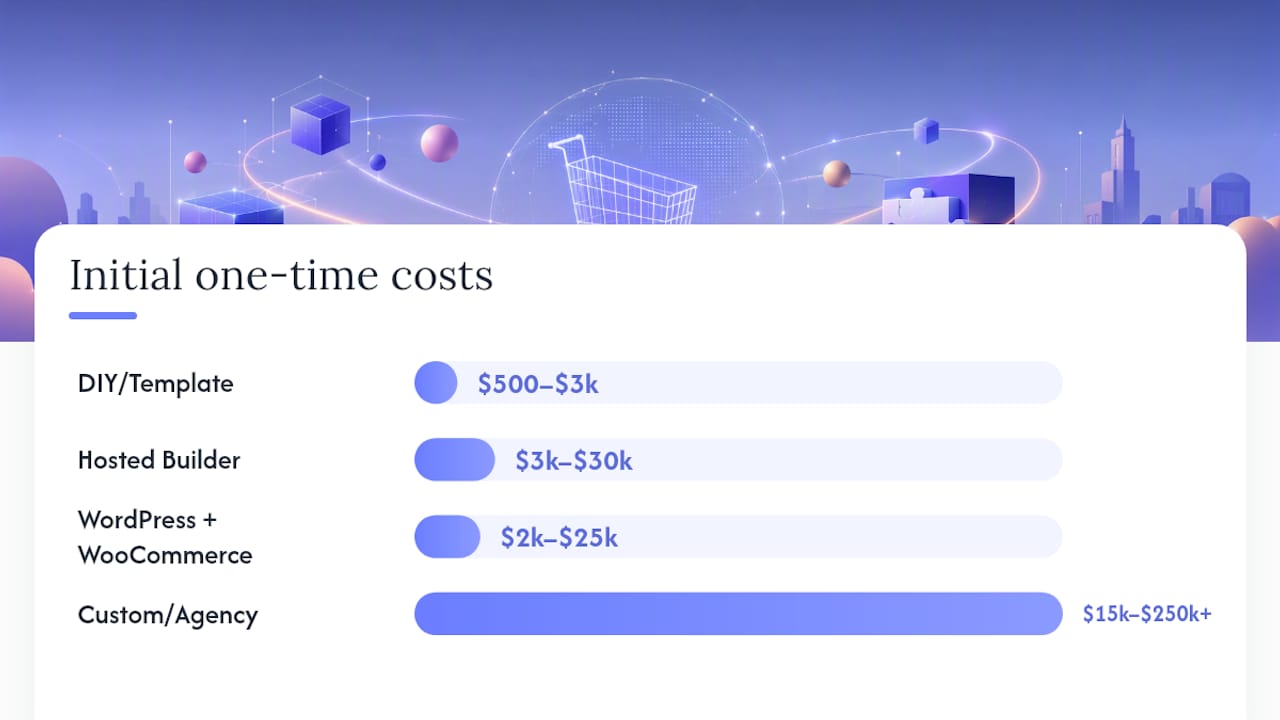
What are all the line items you need to budget for?
Most quotes you receive will bundle several of these into a single number. Push back and ask for itemization. Here’s what you’re actually paying for:
- Domain name: generally a modest annual cost for standard domains, with premium domains costing substantially more if purchased from resellers.
- Hosting: $15–$50/month for shared or managed WordPress hosting (WP Engine, Kinsta, SiteGround). Dedicated or cloud hosting for high-traffic stores: $100–$500+/month.
- SSL certificate: Included free with most hosted SaaS platforms and many managed hosts via Let’s Encrypt. Self-managed servers may require a paid certificate ($50–$200/year).
- Theme or template: $50–$350 for a premium commercial theme. Custom theme design: $2,000–$10,000+.
- Plugins and apps: $0–$600+/month depending on your stack. A typical mid-range store uses email marketing (Klaviyo, $45–$150/month), reviews (Yotpo or Judge.me, $0–$119/month), loyalty, live chat, and search apps.
- Payment processing fees: typically percentage-based plus fixed fees per transaction; costs increase with sales volume.
- Shipping and fulfillment integrations: ShipStation, EasyPost, or Shippo add $9–$99/month. Custom carrier rate logic or 3PL integrations can add $2,000–$10,000 in development time.
- PCI DSS compliance: Hosted SaaS platforms often include PCI-level protections; self-hosted stores may require paid scanning, remediation, and ongoing compliance activity. Budget $200–$1,200/year for a self-hosted store’s compliance program.
- ADA/accessibility remediation: The U.S. Department of Justice’s ADA guidance requires web accessibility for public-facing commerce sites. Remediation audits run $1,500–$5,000; ongoing monitoring tools (accessiBe, AudioEye) add $49–$199/month.
- Development and design time: The largest variable. A freelancer at $75–$125/hour and an agency at $125–$250/hour produce materially different scopes for the same budget. A 40-hour freelancer engagement costs $3,000–$5,000; a 200-hour agency project runs $25,000–$50,000.
- QA and launch support: Often omitted from quotes. Budget 10–15% of development cost for testing, bug fixes, and go-live support.
- Content and photography: Product photography runs $25–$75 per SKU professionally. Copywriting for 50 product pages: $1,500–$5,000.
Baseline hosting and apps for a non-ecommerce site run $15–$150/month; ecommerce adds payment processing, fulfillment integrations, and a heavier app stack that typically doubles or triples that baseline.
Pro Tip: Ask every vendor to separate “platform and hosting” from “development labor” from “third-party app subscriptions” in their quote. A $10,000 proposal that buries $4,000 in annual app subscriptions is a $10,000 year-one cost and a $4,000/year ongoing commitment — not a one-time fee.
What does a real first-year budget look like by business type?
These four scenarios reflect realistic U.S. builds in 2026. They are not minimums or aspirational figures — they’re the numbers you should pressure-test your proposals against.
| Business Type | Build Approach | First-Year Total | Ongoing (Year 2+/month) |
|---|---|---|---|
| Digital product microstore (e-books, templates, courses) | Hosted builder (Squarespace or Shopify) | $4,000–$8,000 | $80–$200 |
| Small physical goods boutique (50–200 SKUs) | Shopify or WooCommerce + freelancer | $8,000–$20,000 | $200–$500 |
| Subscription box or membership service | Shopify + custom subscription logic | $15,000–$35,000 | $400–$700 |
| Mid-market custom store (500+ SKUs, ERP integration) | Custom agency build | $50,000–$100,000 | $1,000–$3,000 |
Digital product microstore: Low catalog complexity keeps costs down. The main cost driver is the digital delivery mechanism (SendOwl, Payhip, or a native Shopify digital app) and email automation setup. Payment processing fees on digital goods are the same as physical, so Stripe or PayPal costs scale with revenue.
Small physical goods boutique: Catalog photography and product data entry are frequently the hidden time sink. A 150-SKU store with professional photos and written descriptions adds $5,000–$12,000 in content costs that most quotes don’t include. Shipping integration (ShipStation or native Shopify Shipping) adds $20–$50/month.
Subscription service: The complexity here is billing logic, not catalog size. Custom subscription rules — pause, skip, swap, gifting — require either a dedicated app (Recharge at $99–$499/month) or custom development. Churn management and dunning email flows add another $50–$150/month in tooling.
Mid-market custom store: Integration complexity is frequently the single largest line-item for mid-market builds, often pushing projects into higher budget bands. A single ERP integration (NetSuite, SAP Business One) can add $15,000–$40,000 to a build. Stores with 500+ SKUs also need advanced search and faceting, which adds $3,000–$8,000 in development time.
How do you turn these estimates into a real budget and timeline?
Knowing the ranges is step one. Translating them into a phased budget you can defend to a stakeholder or a bank is step two. Here’s how to do it without leaving money on the table or running out of runway at launch.
- Define your catalog scope first. Count your SKUs, variants, and product types before you talk to any developer. A 50-SKU store and a 500-SKU store are different projects even on the same platform.
- Separate one-time from recurring costs in your spreadsheet. Year-one total is not your ongoing cost. Build a 24-month model: one-time costs in month 1, recurring costs every month, and a 10% contingency buffer for scope changes.
- Allocate budget by phase. A typical agency project breaks down roughly as: discovery and scoping (10%), design (20%), development (45%), content and data migration (10%), QA and testing (10%), launch and go-live support (5%).
- Set a timeline by approach. DIY builds can launch in 1–4 weeks. A hosted builder project with a freelancer takes 2–8 weeks. A WordPress + WooCommerce build with a small agency takes 4–12 weeks. A custom agency build takes 3–9 months from signed contract to go-live.
- Budget for post-launch maintenance. The first 90 days after launch typically generate 20–30% of total project cost in bug fixes, content updates, and conversion optimization work. This is not optional — it’s the cost of operating a live store.
- Get three itemized quotes minimum. One quote is a data point. Three quotes reveal the market rate and expose scope gaps. Ask each vendor to quote the same written scope document, not their interpretation of your verbal description.
- Reserve a marketing budget separate from build cost. A $15,000 store with $0 in marketing budget generates $0 in revenue. Budget at minimum 20–30% of your build cost for first-year SEO, paid acquisition, and email setup.
Typical first-year budget allocation for a $20,000 hosted builder project:
- Discovery and scoping: $2,000
- Design (theme customization, UX): $4,000
- Development (apps, integrations, custom features): $9,000
- Content and product data: $2,500
- QA, launch, and go-live support: $1,500
- Year-one hosting, apps, and platform fees: $3,000–$6,000 (recurring, on top of build)
Where should you save and where should you spend?
The instinct to cut cost everywhere is understandable. It’s also how you end up rebuilding your store 18 months after launch. Here’s where the tradeoffs actually matter.
Save here without regret:
- Use a commercial theme ($50–$350) instead of a fully custom design for your first store. A well-configured Shopify or WooCommerce theme converts nearly as well as a custom design for stores under $500K/year in revenue.
- Postpone complex integrations (ERP, PIM, custom pricing rules) until you’ve validated your product-market fit. A manual CSV import process is slower but costs $0 in development.
- Start with a single payment gateway. Stripe covers the vast majority of U.S. transactions. Adding PayPal as a secondary option adds conversion for some demographics but adds integration complexity.
Spend here without hesitation:
- Performance and hosting. A store that loads in under 2 seconds converts at a materially higher rate than one that loads in 4 seconds. Don’t cheap out on hosting to save $30/month.
- PCI compliance and security. A self-hosted store that skips PCI DSS compliance is a liability, not a cost savings. A single breach remediation costs more than years of compliance tooling.
- Accessibility. ADA web accessibility requirements apply to public-facing commerce sites. Retrofitting accessibility after launch costs 3–5× more than building it in from the start.
The false economy that costs the most: Choosing a $3,000 freelancer build over a $12,000 agency build to save $9,000 upfront often results in a store that needs a full rebuild within 24 months — at a cost that exceeds what the agency would have charged. The rollback cost of a poorly architected store is rarely visible in the original quote.
Pro Tip: Defer year-2 features to year 2. Write them into the contract as a “phase 2 scope” with rough estimates, but don’t pay for them at launch. Phased investment lets you validate revenue before committing to expensive integrations.
For a useful perspective on the real business impact of underinvesting in your web presence, this analysis of DIY vs. professional builds for small businesses makes the cost-of-inaction case clearly.
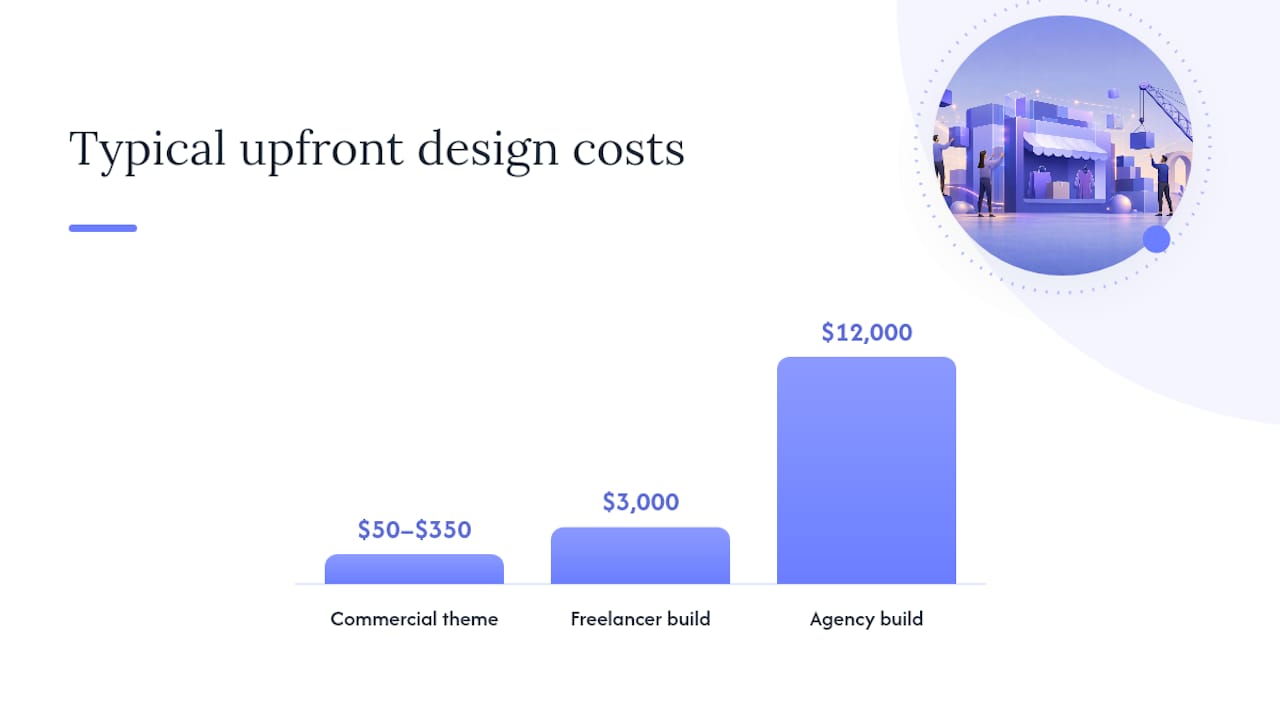
What should you ask a developer or agency before signing anything?
A proposal is a sales document. Your job is to turn it into a contract with teeth. These questions separate serious vendors from order-takers.
Questions that reveal delivery model and responsibility:
- Who owns the code and the hosting account at project end? (You should.)
- What platform, framework, and hosting stack will you use, and why?
- How do you handle scope changes — fixed-price change orders or hourly overages?
- What does your QA process look like, and who signs off on acceptance?
Questions that reveal post-launch reality:
- What’s included in your warranty period, and how long does it last?
- Do you offer a maintenance retainer, and what does it cover?
- What happens if a third-party plugin you integrated breaks six months after launch?
- Have you built on this platform before, and can you share a comparable reference?
Red flags in proposals:
- No discovery phase or requirements document before a fixed price is quoted
- Vague deliverables (“ecommerce website with all features”) with no milestone breakdown
- No acceptance criteria — how do you know when the project is done?
- Timeline under 4 weeks for anything above a basic template build
- No mention of PCI compliance, SSL setup, or security configuration
What a fair fixed-price scope should include:
- Discovery and requirements sign-off (written, not verbal)
- Design mockups with a defined revision round count
- Development milestones with client review gates
- Acceptance criteria for each deliverable
- Change control process with written approval for any out-of-scope work
- Go-live checklist and post-launch support window (minimum 30 days)
How these estimates were calculated
These ranges are grounded in U.S. market data, not global averages. The methodology:
- Market scope: U.S.-based stores, U.S. agency and freelancer hourly rates ($75–$250/hour), U.S. platform pricing as published by vendors in 2026.
- Catalog assumptions: 25–500 SKUs for small-to-mid scenarios; 500+ SKUs for mid-market and enterprise scenarios.
- TCO horizon: Three-year total cost of ownership perspective, not just year-one build cost.
- Primary sources weighted: Vendor-published pricing pages (Shopify, Wix, Squarespace, BigCommerce) for platform costs; aggregated project-quote datasets for freelancer and agency ranges; industry planning guides for integration complexity adjustments.
- Adjustments for your situation: High-cost metro markets (NYC, SF) add 15–25% to agency rates. B2B requirements (custom pricing, account-based access, quote workflows) add $20,000–$80,000 to any mid-market build. Headless/composable architecture adds $50,000–$150,000 to baseline custom build costs.
- What these ranges do not cover: Offshore development (which can reduce labor costs by 40–60% with corresponding quality and communication risk), marketplace-only strategies (Amazon, Etsy), or pure mobile-app commerce builds.
The cost surprises we see most often in client work
Three budget failures show up repeatedly in client projects, and they’re almost always avoidable with better scoping upfront.
First: payment processing fees are treated as a rounding error until the store is live. That’s $18,000/year in processing costs that rarely appears in a pre-launch budget model.
Second: the app stack grows faster than anyone plans for. A Shopify store that launches with four paid apps typically has twelve within 18 months. Each app solves a real problem, but the cumulative subscription cost ($400–$800/month) often exceeds the original platform fee. The discipline of auditing your app stack quarterly is worth more than any individual app.
Third: the first major platform migration is always more expensive than the original build. Stores that select platforms mainly by initial cost often outgrow them in a few years and then face costly platform migration projects. Choosing a platform with a credible growth path — even if it costs $200/month more — is almost always the lower three-year TCO.
A custom-build approach, where the architecture is designed around your actual requirements rather than a platform’s default assumptions, typically re-aligns cost versus value for SMBs that have validated their revenue model and know their integration requirements. It’s not the right starting point for every business, but for stores that have hit the ceiling of a hosted builder, it’s the move that stops the cycle of rebuilds.
Ctrlaltorion builds ecommerce sites that don’t need rebuilding in 18 months
Most SMB owners who contact us have already spent $8,000–$15,000 on a store that can’t handle their actual requirements. The platform was chosen for its marketing page, not its architecture. The app stack is a patchwork. The developer is unreachable.
Ctrlaltorion builds custom ecommerce platforms designed around your catalog, your integrations, and your growth trajectory — not a SaaS platform’s default assumptions. Our discovery process produces a written scope with milestones, acceptance criteria, and a fixed-price proposal before any development begins. You know exactly what you’re getting, when you get it, and what it costs. No lump-sum mystery quotes, no scope creep surprises, no post-launch abandonment. For SMB owners who’ve validated their product and are ready to build something that scales, request a discovery call at Ctrlaltorion and get a ballpark range within 48 hours.
Sources
5 refsThese are the primary sources used to calibrate the ranges and methodology in this guide. Platform pricing pages reflect published U.S. rates as of 2026; project-quote datasets reflect aggregated freelancer and agency proposals.
- Ecommerce Website Cost (The Complete 2026 Guide)bigcommerce.com
- Ecommerce Website Cost 2026: Budget & TCO Guide | Elogic Commerceelogic.co
- Ecommerce Website Cost by Platform 2026 — Real Dataprojectcostestimator.com
- How much a website costs varies from free to hundreds of thousands of dollars. It all depends on what you want out of the website…forbes.com
- PCI Security Standards Councilpcisecuritystandards.org
comments
loading comments…
No comments yet. Start the thread.