Disclosure: some links below are Amazon affiliate links (tag cao04-20). Costs you nothing; the picks don’t change based on that. Every spec, price, and USPS policy detail below is sourced at the bottom.
Here’s the thing nobody tells you when you start shipping your own orders off a kitchen scale: you’re not actually setting the weight on your package. You’re setting a guess, and USPS is going to check it, and USPS’s number is the one that counts. If your guess is off, you don’t find out at the counter. You find out weeks later as a quiet debit against your postage account — or you find out never, because you’ve been quietly overpaying on every single label since the day you started.
That’s not a hypothetical. USPS runs an automated system called Automated Package Verification (APV) that scans and re-weighs packages as they move through processing, checks the declared weight and dimensions against what the label actually paid for, and adjusts the difference directly through whatever platform you printed the label with — Click-N-Ship, Stamps.com, Endicia, PayPal, eBay, EasyPost, Pitney Bowes, all of it. If you underpaid, it debits you. If you overpaid, it’s supposed to credit you, though in practice most sellers never go looking for that credit. Either way, the number your scale gave you when you printed the label isn’t the number that determines what you actually pay. USPS’s own re-weigh is.
A kitchen scale — or a bathroom scale, or the “it’s close enough” eyeball method a lot of small sellers start with — was never built to survive that check. This piece is about the $36 fix.
Why a kitchen scale actively works against you here
A kitchen scale isn’t just “less accurate” in some abstract sense. It fails at this specific job for three concrete reasons:
It doesn’t read in the units that matter. Most kitchen scales are built around cooking — grams and small fractions of a pound, capped at 5-11 lbs, because nobody needs to weigh a 20 lb roast. USPS bills in whole-ounce and whole-pound increments, rounded up. A scale that reads in grams or rounds to the nearest 0.1 lb is translating between two different measurement philosophies every single time, and that translation is where errors creep in.
It has no tare function built for packaging. “Tare” — zeroing out the weight of the box, packing material, and label paper before you weigh the contents — is standard on every real shipping scale and mostly absent or clumsy on kitchen scales. Skip it, or do it manually and imprecisely, and you’re either weighing your box or padding your paranoia margin by adding an extra ounce “just in case,” which is its own quiet tax.
It maxes out too low. Most kitchen scales cap between 5 and 11 lbs. The moment you ship anything heavier — and if you sell almost anything physical, you eventually will — the kitchen scale simply can’t weigh it, and you’re back to guessing or borrowing the bathroom scale (which is worse: bathroom scales are built for 1-2 lb precision at 150+ lbs, not ounce precision at 2 lbs).
None of this means your kitchen scale is a bad kitchen scale. It means it’s the wrong tool, doing a job it was never designed for, and the gap between “close enough for a recipe” and “exact enough for a USPS label” is exactly where the money leaks out.
The pick: Accuteck ShipPro W-8580
Accuteck ShipPro W-8580, 110 lb Digital Shipping Scale
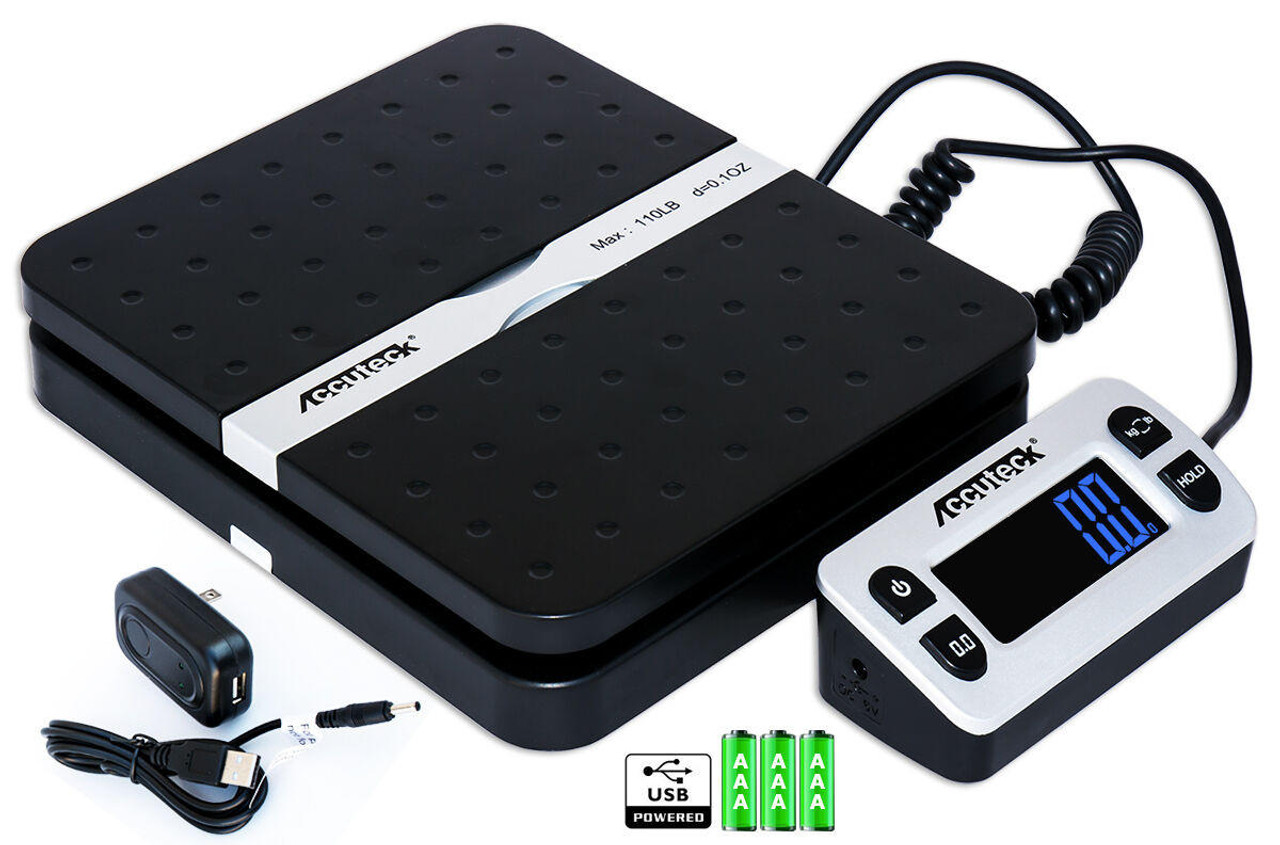 The Accuteck ShipPro W-8580: 110 lb capacity, 0.1 oz readability, detachable backlit display on an 18-inch cable so you can read it without crouching over the platform. Photo: Redstag Supplies product listing.
| Spec | Detail |
|---|---|
| Capacity | 110 lbs |
| Readability | 0.1 oz graduation; minimum start weight around 10g / 0.5oz |
| Display | Detachable, backlit, on an ~18-inch cable |
| Power | 4×AAA batteries, USB cable, or included 5V AC adapter |
| Platform | ~7.8 × 6.8 in, with a two-way fold-up mailer holder for envelopes |
| Functions | Tare, hold, auto-shutoff on battery power |
| Price (current) | Roughly $36-45 depending on retailer and color |
Check current Accuteck ShipPro W-8580 pricing here.
This isn’t the cheapest scale on the market and it isn’t the most expensive. It’s the middle of the road on purpose: 0.1 oz readability (well past what USPS actually bills to), a 110 lb capacity that covers everything from a padded envelope to a genuinely heavy box, real tare and hold functions, and three power options so a dead battery on a Monday morning doesn’t stop you from shipping. If you’re weighing almost everything under 5 lbs and never anything heavier, a cheaper 50 lb model saves a few dollars. If you regularly ship boxes over 100 lbs, you need a bench or platform scale, not this category at all — more on both of those below.
USPS doesn’t bill you today. It bills you later.
This is the part that catches sellers off guard, and it’s worth being precise about because it’s the actual mechanism that makes an inaccurate scale expensive, not just theoretically imprecise.
When you print a label through Click-N-Ship or a PC Postage vendor, USPS’s Automated Package Verification system scans the package again during processing — weighing it and measuring it — and compares that against what the label paid for. If your declared weight or dimensions don’t match what USPS’s own equipment measures, the system flags the discrepancy and adjusts your account directly through whatever platform issued the label: underpaid packages get debited the difference, overpaid ones are supposed to get credited back. You generally have 60 days to dispute a charge you believe is wrong.
The practical effect: a scale that reads light doesn’t save you money. It defers the charge and adds the friction of a surprise line-item adjustment showing up on your account days or weeks after the package already shipped, disconnected from the order it belongs to, at a moment when you’ve moved on to a hundred other packages and have no easy way to tell whether the adjustment is legitimate or a processing error. A scale that reads heavy, on the other hand, doesn’t get “caught” by anything — you just quietly pay more than you owed, on every label, forever, and nobody ever flags that for you.
Both failure modes point to the same fix: a scale accurate enough that your declared weight matches USPS’s re-weigh closely enough that neither direction of error is happening at scale.
Dimensions get checked too, and getting them wrong has its own flat fee
Weight isn’t the only thing USPS verifies. For packages larger than one cubic foot, USPS calculates dimensional (DIM) weight — length × width × height, divided by 139, rounded up — and bills whichever number is higher, actual weight or DIM weight. If the dimensions you declared don’t match what their equipment measures, there’s a flat $3 dimensional-noncompliance fee on top of any rate difference. A scale doesn’t fix a dimensions problem, but the same discipline that makes you weigh accurately — actually measuring instead of eyeballing — is the same discipline that keeps you honest on box dimensions, and the two errors tend to travel together: sellers guessing at weight are usually also guessing at “about a foot” on dimensions.
Note: USPS collapsed the four sub-1-lb Ground Advantage weight tiers (4oz / 8oz / 12oz / 15.99oz) into a single flat rate per zone at Commercial pricing on July 12, 2026 — about 2 months old as of this writing (September 10, 2026). Below-Commercial pricing through most shipping platforms still uses the old ounce tiers for shipments within the contiguous US, but anything going to Alaska, Hawaii, Puerto Rico, military addresses, or rural ZIP codes now bills at the top sub-pound rate regardless of whether the package is 2 ounces or 15.99 ounces. That actually lowers the stakes of small ounce-level errors for a slice of your shipments — but it doesn’t touch the 1lb+ tiers, where getting the pound right still directly changes the price, and it doesn’t touch DIM weight at all.
The math, kept honest
It’s tempting to back into a precise “this scale saves you $X/month” number, and most affiliate posts do exactly that with numbers that don’t hold up to scrutiny. The honest version: the size of the leak depends entirely on your error direction and your volume, and the only way to know your actual number is to compare your scale’s reading against a verified-accurate one for a week.
Here’s the framework, not a fabricated total:
| If your current method… | What actually happens | Who “catches” it |
|---|---|---|
| Reads consistently light (kitchen scale rounding down, or skipping tare) | You underpay on the label | USPS APV, weeks later, as a debit through your postage vendor |
| Reads consistently heavy (padding for “safety,” bad tare) | You overpay on every single label | Nobody — it’s a silent, permanent tax you’re paying yourself |
| Is inconsistent (drifts, isn’t level, environmental interference) | Some packages under, some over | A mix of both, plus wasted time investigating adjustments that don’t match your records |
The one number worth actually running for your own shop: take your current monthly package count, weigh 20 recent shipments on a scale you trust is accurate (a properly calibrated shipping scale, or a certified scale at a shipping counter), and compare those readings against what you originally declared. If you’re consistently off by even half an ounce in either direction across a meaningful sample, multiply that gap by your monthly volume and you’ll have a real number specific to your shop — not someone else’s guess dressed up as universal math.
A worked comparison: two sellers, same volume
Seller A ships 200 packages a month off a $12 kitchen scale that’s never been checked against anything, sitting on an uneven shelf near a box fan that runs most of the day (airflow across a load cell is a real, documented source of drift on cheap digital scales — it’s not superstition). Some weeks the scale reads light because of the fan; other weeks Seller A adds a “safety ounce” to compensate after getting an APV adjustment that didn’t match expectations. There’s no consistency, no pattern, and no way to audit it after the fact — just a recurring low-grade confusion about why the numbers don’t line up with what got charged.
Seller B ships the same 200 packages a month off a dedicated shipping scale sitting on a stable table away from airflow, tared before every weigh, calibrated against a known weight every few months. The declared weight and the USPS re-weigh match essentially every time. No surprise debits. No silent overpayment. No time spent each month trying to reconcile why the postage bill doesn’t match the label totals. That reconciliation time, multiplied across a year, is often worth more than the $36 the scale cost in the first place — even before counting the dollars from the weight gap itself.
Placement and routine matter as much as the scale
Buying an accurate scale and then using it badly gets you most of the way back to where you started. The actual routine:
- Put it somewhere stable and level — not near a box fan, an HVAC vent, or a table that wobbles when someone walks by. Airflow and vibration are the two most common causes of drift on an otherwise-accurate digital scale, and both are invisible until you know to look for them.
- Tare before every weigh — zero out the box, the packing material, and the label paper before adding the item. This is a five-second habit that fixes the single most common source of small, consistent error.
- Recalibrate periodically using a known-weight object (a set of calibration weights, or anything with a certified, unchanging weight) — most digital shipping scales have a calibration mode, and skipping it for years is how “accurate when new” quietly becomes “off by half an ounce” without anyone noticing.
- Round the way USPS rounds, not the way feels safe. USPS rounds up to the next billing increment regardless of what you do — padding your own number on top of that rounding doesn’t protect you from anything; it just means you’re paying for a rounding buffer twice.
- Spot-check against a certified scale occasionally — most shipping counters and some postal retail locations have certified scales; weighing the same package on both once in a while is the simplest way to catch drift before it costs you meaningfully.
If 110 lbs and $36-45 isn’t the right fit
| Scale | Capacity | Readability | Price range | Best fit |
|---|---|---|---|---|
| Accuteck ShipPro W-8580 (this pick) | 110 lbs | 0.1 oz | ~$36-45 | Balanced choice for most small sellers shipping envelopes through medium boxes |
| A basic 50 lb / 0.1oz postal scale | 50 lbs | 0.1 oz | ~$18-25 | You almost never ship anything over 30 lbs and want the cheapest scale that still beats a kitchen scale |
| A USB-connected scale with shipping-software integration | Varies | Varies | ~$40-70 | You print dozens of labels a day and want weight auto-populated into your shipping software instead of typed in manually |
| A commercial bench/platform scale | 150-400+ lbs | Whole ounce or 0.5 oz | $150+ | You regularly ship boxes over 100 lbs — furniture, appliances, bulk freight-adjacent items — where a countertop scale’s capacity and platform size are both too small |
If your shop is managing inventory across multiple sales channels, the USB-integrated option is worth the extra cost specifically because it removes one more manual-entry step where a typo can introduce the exact error this whole piece is about — a scale that reads correctly but gets mistyped into the label form is just as costly as a scale that reads wrong in the first place.
When not to buy this
If you ship fewer than a handful of packages a month. At genuinely low volume, the total dollar exposure from occasional weight errors is small enough that a $36 dedicated scale may take a long time to “pay for itself” in a strict accounting sense — though the time saved not troubleshooting mismatched postage bills still counts for something.
If you already own an accurate scale that just isn’t labeled “for shipping.” A kitchen scale with a genuine 0.1oz readability mode, a real tare function, and enough capacity for what you actually ship might already do the job — the failure mode this piece describes is specifically about scales that lack those things, not about the word “shipping” printed on the box. Check your current scale’s actual specs before assuming you need a new one.
If you’re shipping almost exclusively via a carrier that weighs and bills you at drop-off, rather than pre-printing labels based on your own declared weight — some local courier and freight arrangements work this way, and if yours does, the specific USPS APV mechanism described here doesn’t apply to you the same way. The core accuracy argument still holds for any dimensional-weight or “customer complains it feels light” scenario, but the urgency is lower.
If your packages regularly exceed 110 lbs. Don’t force a countertop scale to do a platform scale’s job — you’ll damage the scale, get unreliable readings near its maximum capacity, and need to replace it sooner than if you’d bought the right category from the start.
Quick answers
Does a more expensive scale mean more accurate? Not necessarily past a certain point. The jump from “kitchen scale” to “any real 0.1oz shipping scale” is where almost all the accuracy gain happens. Beyond that, extra cost usually buys capacity, build quality, USB integration, or a longer warranty — not meaningfully better precision for a typical small shop’s package sizes.
Do I need to register this scale with USPS or get it certified? No — for standard retail and Click-N-Ship style shipping, there’s no requirement to use a certified scale. Certification requirements exist for some commercial/wholesale metering contexts, not for a small shop printing its own labels.
What if my scale and USPS’s re-weigh still don’t match after I switch? Check placement (airflow, level surface) and your tare routine first — those two things cause more real-world drift than the scale’s inherent precision limit. If it persists, recalibrate using a known weight, and if it still won’t hold a calibration, that’s a defective unit, not a category problem.
Is this worth doing before or after I fix my label printing setup? Either order works, but weight accuracy matters more urgently — a bad label printer costs you reprints and a little time; a bad scale costs you money on every single package, indefinitely, until it’s fixed.
Should I track weights the same way I track barcode inventory? If you want a real audit trail, yes — logging declared weight per order next to what USPS actually billed is the only way to catch drift before it becomes a pattern, the same principle behind keeping any operational number checked against ground truth rather than trusted blindly.
Sources
4 refsAll prices, specs, and policy details accessed September 10, 2026.
- USPS’s official postage verification program — USPS, “Postage Verification” (Automated Package Verification mechanics, DIM weight formula, rounding rules, $3 dimensional-noncompliance fee, adjustment/dispute process)usps.com
- July 12, 2026 Ground Advantage sub-1lb tier change — Pirate Ship, “July 2026 USPS Rate and Rule Changes”support.pirateship.com
- Product specs and current pricing — Redstag Supplies, Accuteck ShipPro W-8580 product listingredstagsupplies.com
- Corroborating specs and pricing — Planet World Trading, Accuteck ShipPro W-8580 product listingplanetworldtrading.com
Bottom line
USPS re-weighs and re-measures your package after you’ve already printed the label, and its number — not yours — decides what you pay. A kitchen scale, built for grams and roast chickens, isn’t equipped to consistently match that number. A dedicated shipping scale with real tare, 0.1 oz readability, and enough capacity for what you actually ship closes that gap for about $36 and the five extra seconds it takes to zero out the box before you weigh the contents. It’s not exciting. It’s the difference between a postage bill that matches your records and one that quietly doesn’t.
comments
loading comments…
No comments yet. Start the thread.